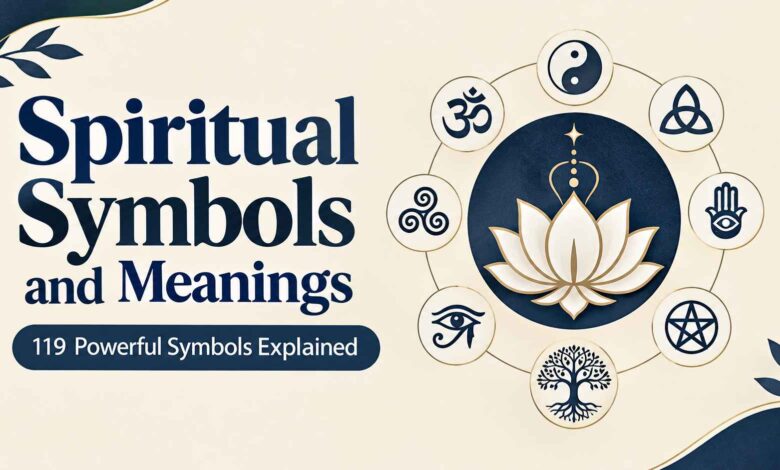
Spiritual symbols and meanings help people express ideas that can be difficult to put into words: protection, faith, transformation, balance, renewal, connection, and the search for something greater than everyday life. A simple shape, object, animal, or pattern can carry very different meanings depending on the culture and tradition behind it.
In this guide, you’ll find 119 spiritual symbols and meanings from religious traditions, mythology, sacred art, nature symbolism, and modern spiritual practice. You’ll also learn how to interpret symbols without assuming that one meaning applies everywhere.
What Are Spiritual Symbols and Meanings?
Spiritual symbols are images, objects, shapes, or patterns used to represent religious, philosophical, cultural, or personal ideas. Their meanings develop through traditions, stories, rituals, and repeated use.
For example, a lotus may represent purity or spiritual growth in South Asian religious traditions, while a tree can symbolize life, ancestry, connection, or the relationship between different realms.
The important point is that symbols do not have one universal dictionary. Meaning depends on context.
A circle may suggest completeness in one setting, while a particular circle-based emblem can have a much more specific meaning within a religious tradition. The same visual element can therefore communicate different ideas to different communities.
119 Spiritual Symbols and Their Meanings
Here is a quick-reference collection of spiritual symbols, followed by deeper explanations of some of the most widely recognized examples.
| # | Spiritual Symbol | Common Meaning |
|---|---|---|
| 1 | Ankh | Life, vitality, eternal existence |
| 2 | Lotus | Purity, spiritual growth, renewal |
| 3 | Om | Sacred sound, consciousness, spiritual reality |
| 4 | Yin and Yang | Complementary forces, balance |
| 5 | Hamsa | Protection and blessing |
| 6 | Eye of Horus | Protection, healing, royal power |
| 7 | Tree of Life | Connection, growth, ancestry |
| 8 | Mandala | Wholeness, contemplation, cosmic order |
| 9 | Spiral | Growth, cycles, movement |
| 10 | Infinity Symbol | Continuity, endlessness |
| 11 | Cross | Christian faith, sacrifice, salvation |
| 12 | Crescent Moon | Lunar cycles, faith, renewal |
| 13 | Phoenix | Rebirth and transformation |
| 14 | Ouroboros | Cycles, renewal, eternity |
| 15 | Feather | Freedom, spirituality, elevation |
| 16 | Star of David | Jewish identity and faith |
| 17 | Dharma Wheel | Buddhist teaching and the Eightfold Path |
| 18 | Caduceus | Hermes, communication, commerce |
| 19 | Fleur-de-lis | Purity, royalty, Christian associations |
| 20 | Triskele | Cycles, movement, threefold patterns |
| 21 | Nazar / Evil Eye | Protection from harmful envy |
| 22 | Pentagram | Fivefold symbolism, elements, protection |
| 23 | Labyrinth | Reflection and spiritual journey |
| 24 | Sun | Life, light, vitality |
| 25 | Moon | Cycles, change, reflection |
| 26 | Eye | Awareness, observation, divine sight |
| 27 | Heart | Love, compassion, devotion |
| 28 | Dove | Peace, purity, the Holy Spirit in Christianity |
| 29 | Dove and Olive Branch | Peace and reconciliation |
| 30 | Butterfly | Transformation and change |
| 31 | Snake | Renewal, healing, transformation |
| 32 | Eagle | Vision, strength, spiritual elevation |
| 33 | Owl | Wisdom, mystery, observation |
| 34 | Deer | Gentleness, grace, connection with nature |
| 35 | Wolf | Loyalty, instinct, community |
| 36 | Bear | Strength, protection, resilience |
| 37 | Lion | Courage, authority, strength |
| 38 | Elephant | Wisdom, strength, memory |
| 39 | Horse | Freedom, movement, vitality |
| 40 | Whale | Depth, intuition, emotional awareness |
| 41 | Butterfly Knot | Change and interconnectedness |
| 42 | Celtic Knot | Continuity and interconnectedness |
| 43 | Vesica Piscis | Creation, intersection, sacred geometry |
| 44 | Flower of Life | Geometric harmony and interconnectedness |
| 45 | Seed of Life | Creation and potential |
| 46 | Sri Yantra | Meditation and sacred geometry |
| 47 | Merkaba | Mystical ascent and spiritual symbolism |
| 48 | Hexagram | Balance and sacred geometry |
| 49 | Seven-Pointed Star | Sevenfold spiritual symbolism |
| 50 | Four-Pointed Star | Direction, balance, guidance |
| 51 | North Star | Guidance and direction |
| 52 | Shooting Star | Hope, wishes, change |
| 53 | Morning Star | Renewal and illumination |
| 54 | Rainbow | Promise, hope, divine connection |
| 55 | Lightning Bolt | Power, revelation, sudden change |
| 56 | Fire | Transformation, purification, energy |
| 57 | Water | Renewal, emotion, cleansing |
| 58 | River | Flow, journey, change |
| 59 | Ocean | Mystery, depth, vastness |
| 60 | Mountain | Stability, aspiration, spiritual ascent |
| 61 | Cave | Reflection, mystery, inner journey |
| 62 | Stone | Stability, endurance, grounding |
| 63 | Crystal | Clarity and focused intention |
| 64 | Quartz | Clarity and symbolic purification |
| 65 | Key | Access, knowledge, discovery |
| 66 | Door | Transition and opportunity |
| 67 | Bridge | Connection and transition |
| 68 | Anchor | Stability and hope |
| 69 | Compass | Direction and guidance |
| 70 | Bell | Attention, ritual, awakening |
| 71 | Candle | Light, remembrance, prayer |
| 72 | Lantern | Guidance through darkness |
| 73 | Incense | Prayer, ritual, purification |
| 74 | Rosary | Prayer and devotion |
| 75 | Prayer Beads | Repetition, meditation, devotion |
| 76 | Staff | Authority, guidance, journey |
| 77 | Wheel | Movement, cycles, spiritual law |
| 78 | Conch Shell | Sacred sound and ritual |
| 79 | Lotus Seed | Potential and renewal |
| 80 | Olive Branch | Peace and reconciliation |
| 81 | Olive Tree | Peace, endurance, abundance |
| 82 | Acorn | Potential and future growth |
| 83 | Oak Tree | Strength and endurance |
| 84 | Apple | Knowledge, temptation, abundance |
| 85 | Pomegranate | Fertility, abundance, life |
| 86 | Rose | Love, beauty, devotion |
| 87 | Lily | Purity and renewal |
| 88 | Sunflower | Light, optimism, devotion |
| 89 | Lavender | Calm and remembrance |
| 90 | Lotus Mandala | Meditation and spiritual development |
| 91 | Sacred Heart | Divine love and Christian devotion |
| 92 | Ichthys | Christian faith |
| 93 | Chi Rho | Christ and Christianity |
| 94 | Alpha and Omega | Beginning and end |
| 95 | Khanda | Sikh identity and spiritual principles |
| 96 | Dharma Wheel | Buddhist teaching |
| 97 | Vajra | Strength, indestructibility, spiritual power |
| 98 | Bodhi Tree | Enlightenment and awakening |
| 99 | Endless Knot | Interdependence and continuity |
| 100 | Tibetan Bell | Wisdom and ritual |
| 101 | Torii Gate | Transition into sacred space |
| 102 | Shinto Shimenawa | Sacred boundary and purification |
| 103 | Ganesha | Wisdom, beginnings, overcoming obstacles |
| 104 | Shiva Lingam | Hindu sacred symbolism |
| 105 | Nataraja | Cosmic dance and transformation |
| 106 | Garuda | Protection and divine power |
| 107 | Trident | Power and Hindu divine symbolism |
| 108 | Dreamcatcher | Protection in certain contemporary Indigenous-inspired contexts |
| 109 | Medicine Wheel | Four-direction symbolism in some Indigenous traditions |
| 110 | Scarab | Renewal and protection in ancient Egyptian symbolism |
| 111 | Eye of Ra | Solar power and protection |
| 112 | Was Scepter | Authority and power in ancient Egypt |
| 113 | Djed Pillar | Stability and endurance |
| 114 | Tyet Knot | Isis and protective symbolism |
| 115 | Ouroboros | Cyclical existence and renewal |
| 116 | Labrys | Double axe; historical and modern symbolic uses |
| 117 | Laurel Wreath | Victory, achievement, honor |
| 118 | Olive Crown | Peace, victory, honor |
| 119 | Sacred Circle | Wholeness, unity, cycles |
1. Ankh: The Egyptian Symbol of Life
The ankh is one of the most recognizable symbols associated with ancient Egypt. It resembles a cross topped by a loop and appears frequently in Egyptian art.
It is commonly connected with life, vitality, and continued existence. Ancient Egyptian representations sometimes show gods presenting or holding the ankh, reinforcing its connection with life-giving power.
The symbol is much older than many modern spiritual interpretations. Archaeological objects from the ancient Near East also demonstrate that ankh imagery circulated beyond the narrow boundaries of modern popular culture.
Today, the ankh appears in jewelry, artwork, tattoos, historical recreations, and modern spiritual aesthetics.
2. Lotus: Growth Through Difficulty
The lotus flower is an important symbol in several South Asian religious and artistic traditions.
Because the lotus grows from water and rises above its environment to bloom, it is often associated with purity, spiritual development, awakening, and transcendence.
Its symbolism should not be reduced to a generic idea of “overcoming hardship.” In Buddhist and Hindu contexts, the lotus has specific religious associations that developed over centuries.
The lotus also appears extensively in historical Buddhist art. The Metropolitan Museum of Art, for example, documents lotus imagery in ancient Gandharan material from the region of present-day Pakistan.
3. Om: Sacred Sound and Consciousness
Om, written as ॐ, is one of the most recognizable sacred symbols associated with Hindu traditions and is also important in related Indian religious contexts.
It is connected with sacred sound, meditation, and ideas about ultimate reality. In modern yoga culture, the symbol is often used to represent meditation and spiritual awareness.
However, Om is more than a decorative “yoga symbol.” Its meaning comes from religious and philosophical traditions in which sound, recitation, and contemplation have an important role.
4. Yin and Yang: Complementary Opposites
The familiar black-and-white yin-yang symbol represents complementary forces rather than a simple battle between good and evil.
The two sides depend on each other, and each contains a small portion of the other. The symbol therefore works particularly well as an image of balance, relationship, change, and interdependence.
It is associated with Chinese philosophical traditions, particularly Daoist thought, although the broader concept of yin and yang has a long intellectual history in China.
5. Hamsa: Protection and Blessing
The Hamsa, usually shown as an open hand, is found in Jewish, Islamic, and broader Middle Eastern and North African cultural contexts.
It is commonly associated with protection, blessing, and defense against harmful forces, although interpretations vary by community.
The word hamsa relates to the number five in Arabic. The hand’s widespread use in jewelry and decorative objects has also made it a familiar contemporary symbol.
It is important to distinguish the Hamsa hand from the Sanskrit term hamsa, which can refer to a sacred goose or swan in South Asian traditions. The latter has its own religious symbolism; the Metropolitan Museum documents the hamsa bird in Indian and Buddhist art.
6. Eye of Horus: Protection and Restoration
The Eye of Horus comes from ancient Egyptian religious symbolism and is associated with Horus, a major Egyptian deity.
It is often interpreted through themes of protection, restoration, royal authority, and healing. Modern jewelry and tattoos sometimes simplify the symbol into a general sign of protection, but its original mythology provides a much richer context.
It is also different from the later and broader “all-seeing eye” imagery often grouped with it online.
7. Tree of Life: Connection and Continuity
The Tree of Life is not one single symbol belonging to one universal religion.
Trees have been used symbolically across many traditions because their roots, trunk, branches, fruit, seasonal cycles, and relationship with the earth naturally lend themselves to ideas about life, ancestry, growth, connection, and continuity.
Different traditions give their own versions very different meanings. For that reason, “Tree of Life” should usually be treated as a family of related symbols rather than one fixed icon.
8. Mandala: A Visual Focus for Contemplation
A mandala is generally a structured diagram organized around a centre. Mandalas have important roles in Hindu and Buddhist traditions, where they can represent cosmological structures and serve contemplative purposes.
The word is now widely used for circular geometric artwork and coloring designs, but modern decorative mandalas should not automatically be treated as equivalent to traditional religious mandalas.
The Metropolitan Museum notes that mandalas in Himalayan Buddhist art can function as diagrams of the cosmos and as aids for meditation.
9. Spiral: Cycles, Growth, and Movement
The spiral is one of the simplest recurring forms in symbolic art.
Because it moves outward or inward from a centre, people commonly associate it with growth, development, cycles, movement, and transformation.
Its meaning is not universal, however. A spiral found in an archaeological site must be interpreted within its particular historical and cultural context rather than automatically being assigned a modern “spiritual” definition.
10. Infinity Symbol: Endless Continuity
The sideways figure eight, ∞, originated as a mathematical notation and later became popular in broader cultural symbolism.
Today it can represent endlessness, continuity, eternal connection, and limitless possibility.
Its modern spiritual meaning is therefore partly a later cultural development rather than an ancient religious symbol.
11. Cross: Faith, Sacrifice, and Christian Identity
The cross is central to Christianity and is associated especially with the crucifixion of Jesus and Christian ideas surrounding sacrifice, salvation, and resurrection.
Cross-like shapes existed before Christianity in many cultures, but that does not mean those earlier uses had the same meaning as the Christian cross.
Context matters enormously. A Christian cross, an ancient geometric cross, and a modern decorative cross may look similar while communicating very different ideas.
12. Dharma Wheel: The Buddhist Path
The Dharma Wheel, or dharmachakra, is one of Buddhism’s major symbols.
Its eight spokes are commonly associated with the Noble Eightfold Path, while the wheel itself evokes the Buddha’s teaching and the idea of “turning the wheel of the Dharma.”
Historical Buddhist objects provide strong evidence for this interpretation. A Japanese Buddhist ritual object documented by the Metropolitan Museum explicitly connects its eight spokes with the Eightfold Path.
13. Phoenix: Renewal After Destruction
The phoenix is a legendary bird associated with death and renewal in several mythological traditions.
Modern culture frequently uses it as a straightforward symbol of rebirth, resilience, transformation, and starting again.
It is worth remembering that the phoenix is not identical across every culture. Greek, Egyptian, Chinese, and other traditions have their own mythological birds and stories that are sometimes grouped together under the modern phoenix label.
14. Ouroboros: The Cycle That Feeds Itself
The Ouroboros depicts a serpent or dragon forming a circle by consuming its own tail.
Its circular form lends itself to ideas of cycles, renewal, continuity, eternity, and self-contained existence.
The symbol appears in ancient and later esoteric traditions, including alchemical imagery. Its exact interpretation changes depending on the historical source.
15. Feather: Lightness and Spiritual Association
Feathers have acquired symbolic meanings in many cultures.
They can represent freedom, elevation, communication with the divine, or a connection with birds and the sky.
But claims that every feather color has one universal spiritual message are modern interpretations rather than established universal rules. If you find a feather and want to interpret it personally, it is more useful to consider your own context alongside the cultural tradition you are drawing from.
16. Star of David: Jewish Identity
The Star of David, or Magen David, is a six-pointed star strongly associated today with Jewish identity and Judaism.
Although six-pointed geometric designs existed in different cultures before the symbol became strongly identified with Jewish communities, its modern cultural and religious significance should not be separated from Jewish history.
17. Caduceus: A Commonly Misidentified Symbol
The caduceus is the staff of Hermes in Greek mythology. It is traditionally shown with two snakes and wings.
It is frequently used in modern contexts as a medical symbol, particularly in the United States, but this is historically a common confusion. The Rod of Asclepius, which has a single serpent around a staff, has a much stronger historical connection with medicine.
This is a useful example of why knowing a symbol’s history matters more than relying on a quick internet definition.
18. Pentagram: Fivefold Symbolism
A pentagram is a five-pointed star. Its meaning has changed across different periods and traditions.
It has appeared in ancient contexts, Christian symbolism, Renaissance thought, ceremonial traditions, and modern Pagan and Wiccan practices.
In some contemporary spiritual traditions, it represents the four classical elements plus spirit. In other contexts, it has completely different associations.
19. Labyrinth: A Journey Rather Than a Maze
A labyrinth is a single winding path leading toward a centre.
Unlike a maze, a classical labyrinth is generally not designed around multiple choices and dead ends. Because of its inward movement, it has been adopted in some religious and contemplative settings as an image of reflection, pilgrimage, patience, and an inward journey.
Medieval cathedral labyrinths are particularly well-known examples.
20. Sun: Light, Life, and Vitality
The sun is one of humanity’s most persistent symbols.
Its daily appearance and its importance to life naturally led cultures to associate it with light, vitality, authority, clarity, warmth, and divine power.
Ancient religions developed their own solar deities and imagery, so the meaning of a particular sun symbol should always be considered within its culture.
21. Moon: Cycles and Change
The moon is strongly associated with cycles because its visible appearance changes throughout the month.
It can therefore symbolize change, renewal, time, reflection, mystery, and rhythm.
The crescent has additional religious and cultural meanings in different parts of the world, so a crescent should not automatically be treated as a generic “feminine spirituality” symbol.
22. Butterfly: Transformation
The butterfly is a popular modern symbol of transformation and change because of its dramatic metamorphosis.
Its meaning is particularly common in contemporary art, jewelry, tattoos, and personal-growth language.
Unlike symbols with a clearly documented role in a particular religious tradition, the butterfly’s modern spiritual meaning is often personal or cross-cultural rather than tied to one authoritative interpretation.
23. Snake: Renewal and Duality
The snake can symbolize very different things.
Because snakes shed their skin, they have often been associated with renewal, transformation, and regeneration. At the same time, snakes can represent danger, deception, fertility, healing, or divine power depending on the tradition.
The important lesson is simple: a snake does not automatically mean either good or evil.
24. Dove: Peace and Sacred Meaning
The dove is widely associated with peace, gentleness, and hope.
In Christianity, the dove also has an important association with the Holy Spirit. In other contexts, dove imagery can communicate reconciliation, innocence, or peaceful intentions.
The familiar dove carrying an olive branch combines two separate symbols into a particularly strong image of peace.
25. Rainbow: Hope and Promise
A rainbow can symbolize hope, renewal, beauty after difficulty, and divine promise.
In the Hebrew Bible, the rainbow is associated with God’s covenant with Noah. In modern culture, it also has several meanings unrelated to that biblical context.
This is another reminder that a symbol’s meaning depends on where and how it is used.
26. Fire: Transformation and Purification
Fire can represent energy, transformation, purification, destruction, passion, or illumination.
Religious traditions have used fire in offerings, ceremonies, sacred lamps, candles, and ritual contexts. Because fire can both create warmth and cause destruction, it naturally carries both constructive and destructive associations.
27. Water: Cleansing and Renewal
Water is one of the most common religious symbols worldwide.
It can represent cleansing, life, renewal, rebirth, fertility, and spiritual purification.
Baptism is one of the best-known examples in Christianity, while ritual washing and purification also occur in other religious traditions.
28. Mountain: Ascent and Stability
Mountains naturally suggest height, strength, stability, isolation, and ascent.
Many religious traditions place sacred locations on mountains or use mountains within stories of revelation, pilgrimage, or divine encounter.
The exact meaning varies considerably by tradition.
29. Heart: Love and Devotion
The heart is one of the world’s most recognizable symbols of love, compassion, affection, devotion, and emotional connection.
In Christian imagery, the Sacred Heart has a specific devotional meaning associated with Jesus. Outside that context, the heart has become a much broader symbol of emotional attachment.
30. Candle: Light in Darkness
A candle can symbolize hope, remembrance, prayer, guidance, and spiritual light.
Candles appear in many religious and cultural ceremonies, but their meanings differ according to the ritual.
A candle used during prayer is not necessarily conveying the same message as one placed at a memorial or used during a festival.
Spiritual Symbols by Category
Looking at symbols by theme can make their meanings easier to understand.
Protection Symbols
Common examples include:
- Hamsa
- Nazar
- Eye of Horus
- Ankh
- Certain religious crosses
- Protective amulets
- Vajra
- Sacred knots
Protection symbols are often worn, displayed, carried, or incorporated into architecture.
Historically, amulets and talismans have been used across many cultures. Museum research also documents traditions in which written formulas and religious imagery were believed to offer protection.
Transformation Symbols
These include:
- Phoenix
- Butterfly
- Spiral
- Snake
- Lotus
- Ouroboros
- Fire
- Moon
They work particularly well as personal symbols because each can represent a process rather than a fixed state.
Balance Symbols
Examples include:
- Yin and Yang
- Mandala
- Hexagram
- Sacred circle
- Vesica Piscis
- Dharma Wheel
The exact philosophy behind each is different, so they should not be treated as interchangeable.
Nature-Based Spiritual Symbols
Nature provides some of the oldest symbolic subjects:
- Sun
- Moon
- Stars
- Trees
- Rivers
- Mountains
- Animals
- Flowers
- Birds
- Fire
- Water
These symbols are especially interesting because their meanings often grow from observable qualities of the natural world.
Religious Symbols vs Personal Spiritual Symbols
Not every meaningful symbol is a religious symbol.
A religious symbol usually has a recognized role within a particular faith, tradition, community, scripture, ritual, or historical practice.
A personal spiritual symbol may simply represent something meaningful to an individual.
For example, someone might choose a mountain to represent perseverance. That personal meaning can be genuine without claiming that “the mountain universally means perseverance” in every religion.
This distinction helps you avoid turning personal interpretations into supposed historical facts.
How to Interpret a Spiritual Symbol Correctly
If you encounter a symbol and want to understand it, use context rather than relying on a single definition.
- Identify the symbol accurately. Similar shapes can have completely different histories.
- Find its cultural or religious context. Ask where the symbol comes from.
- Check historical usage. Modern social-media meanings may be much newer.
- Look at how it is being used. A symbol on a temple may mean something different from the same shape on jewelry.
- Separate tradition from personal interpretation. Both can matter, but they should not be presented as the same thing.
- Avoid universal claims. Phrases such as “this always means” are often too simplistic.
This approach is especially important when using symbols from living religious or cultural traditions.
If you enjoy exploring symbolism across different traditions, [ Civilization Names: 300+ Powerful, Ancient & Fantasy Ideas] may be a useful next read.
Spiritual Symbols for Tattoos
Spiritual symbols are popular tattoo choices because a small image can represent a large personal idea.
Before getting one, research the symbol’s actual cultural meaning, especially when it comes from a living religious tradition.
Some commonly chosen options include:
| Symbol | Common Personal Theme |
|---|---|
| Lotus | Growth and renewal |
| Phoenix | Transformation |
| Tree of Life | Family and connection |
| Mandala | Reflection and balance |
| Om | Meditation and spiritual practice |
| Ankh | Life and continuity |
| Butterfly | Personal change |
| Ouroboros | Cycles and renewal |
| Mountain | Strength and perseverance |
| Sun | Vitality and hope |
A tattoo can have a personal interpretation, but that does not erase the original cultural meaning of the symbol. Understanding both makes the choice more thoughtful.
Common Mistakes When Reading Spiritual Symbols
One of the biggest mistakes is assuming every symbol has one fixed meaning.
Other common errors include:
- Treating social-media interpretations as ancient facts
- Confusing similar symbols from different traditions
- Calling every geometric design “sacred geometry”
- Presenting personal interpretations as historical evidence
- Removing a symbol from its cultural context
- Assuming a symbol has the same meaning across religions
- Confusing the caduceus with the Rod of Asclepius
- Treating modern numerology as an established religious doctrine
Good symbolism research should make a distinction between documented tradition, scholarly interpretation, modern usage, and personal belief.
Do Spiritual Symbols Have Universal Meanings?
Some symbolic themes appear repeatedly across cultures, but that does not prove that every culture assigned them exactly the same meaning.
Circles, trees, water, stars, animals, and the sun are visually powerful because they are part of human experience. Different societies can independently develop symbolic interpretations of them.
At the same time, specific symbols such as the Dharma Wheel, Star of David, Ankh, or Khanda have particular historical and religious contexts that should not be flattened into generic spirituality.
The safest approach is to ask: What does this symbol mean here, in this tradition, at this point in history?
FAQ About Spiritual Symbols and Meanings
What are the most common spiritual symbols?
Some widely recognized examples include the lotus, Om, Ankh, Hamsa, Tree of Life, yin-yang, mandala, cross, Dharma Wheel, Eye of Horus, pentagram, spiral, and Ouroboros. Their meanings vary by tradition.
What symbol represents spiritual growth?
The lotus is commonly associated with spiritual development and awakening in South Asian religious traditions. The spiral, butterfly, and tree are also widely used as modern symbols of growth and transformation.
What symbol represents protection?
The Hamsa, Nazar, and Eye of Horus are commonly associated with protection in their respective cultural traditions. Other protective symbols exist in many religions.
What symbol represents rebirth?
The phoenix is one of the clearest modern symbols of rebirth and renewal. The lotus, scarab, snake, and Ouroboros can also carry renewal-related meanings in particular traditions.
Are spiritual symbols the same in every culture?
No. Some symbolic themes recur across cultures, but individual symbols can have very different meanings. Historical and religious context is essential.
Is the evil eye the same as the Hamsa?
No. They are related in some cultural contexts but are distinct symbols. The evil eye refers to a belief in harmful effects associated with envy or a malevolent gaze, while the Hamsa is an open-hand symbol commonly associated with protection and blessing.
What is the difference between a symbol and a talisman?
A symbol communicates an idea or concept. A talisman is an object believed within certain traditions to carry protective, beneficial, or magical properties. The two can overlap when a symbolic image is placed on an object intended for protection.
Can a spiritual symbol have a personal meaning?
Yes. People can attach personal meanings to symbols through memories, experiences, beliefs, or life events. However, personal meaning should be distinguished from the established meaning of a symbol within its original tradition.
What is sacred geometry?
Sacred geometry refers broadly to the use or interpretation of geometric forms in religious, philosophical, or spiritual contexts. Mandalas and certain geometric diagrams are examples, but not every geometric pattern is automatically a sacred symbol.
Do symbols have spiritual power?
That depends on the belief system being discussed. Religions and spiritual traditions may attribute sacred or protective significance to particular symbols, while a psychological or historical approach may focus on their ability to communicate meaning and shape attention. These are different ways of interpreting the same object.
Final Thoughts on Spiritual Symbols and Meanings
Spiritual symbols and meanings are best understood through context, history, and tradition rather than one-line definitions.
A lotus is more than a flower. A Dharma Wheel is more than a circle with spokes. An ankh is more than an attractive piece of jewelry. Each becomes meaningful through the stories, beliefs, rituals, and communities that have used it.
At the same time, you do not need to adopt a particular belief system to appreciate symbolism. A symbol can be historically important, religiously sacred, culturally meaningful, or personally significant — sometimes all at once.
If you are choosing a symbol for artwork, jewelry, meditation, or a tattoo, take time to learn where it comes from and what it means to the people who traditionally use it. That small amount of research can turn a beautiful image into a much more informed and meaningful choice.