Sanskrit Symbols are closely connected with the language, philosophy, spirituality, and artistic traditions of South Asia. You may see Sanskrit letters, sacred sounds, geometric designs, and religious symbols in temples, manuscripts, meditation spaces, jewellery, artwork, and modern spiritual practices.
Sanskrit Symbols can refer to several different things, though. Sanskrit itself is a language, while Devanagari is one script used to write it. Other familiar symbols such as Om, the lotus, yantras, and the Trishula belong to wider Indian religious and philosophical traditions rather than being symbols of the Sanskrit language itself.
This guide explains 15 important symbols and concepts, what they represent, where they come from, and how they are used today.
What Are Sanskrit Symbols?
The phrase Sanskrit symbols is commonly used online to describe visual and written elements connected with Sanskrit and Indian spiritual traditions.
These can include:
- Sanskrit letters and written characters
- Sacred syllables
- Mantras
- Religious symbols
- Geometric diagrams
- Traditional objects
- Devanagari script
- Symbols associated with Hindu philosophy and worship
The important point is that these categories are not identical.
For example, Devanagari is a writing system, while Om is a sacred syllable and symbol. A yantra is a geometric spiritual diagram, whereas a mantra is primarily a sacred verbal formula.
Understanding these differences makes the subject much easier to explore.
Devanagari: The Script Used for Sanskrit
Devanagari is one of the major scripts used to write Sanskrit. It is also used for several modern Indian languages, including Hindi, Marathi, and Nepali.
The script has a distinctive horizontal line running across the top of many letters. Individual characters represent consonants and vowels, while additional marks modify their pronunciation.
For example:
- अ = a
- आ = ā
- इ = i
- क = ka
- म = ma
- न = na
Sanskrit can also be represented using other writing systems, including Roman transliteration. Therefore, Sanskrit should not be confused with Devanagari itself.
The reference article similarly describes Devanagari as a structured script with vowels, consonants, vowel signs, and combined characters.
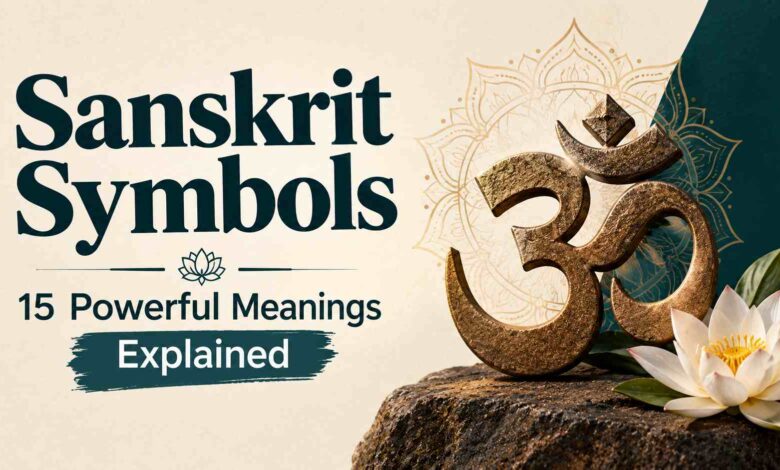
Om or Aum: The Most Recognizable Sacred Symbol
Om, also written Aum, is one of the best-known sacred symbols associated with Indian religions and Sanskrit traditions.
The syllable is traditionally represented in Devanagari as ॐ.
Om has an important place in Hindu philosophical and religious traditions and is frequently used in prayer, meditation, chanting, and sacred texts.
Its sound is often analysed through the components A-U-M, followed by silence. In some philosophical interpretations, these correspond with different states of consciousness.
Om is commonly associated with ideas such as:
- Consciousness
- The sacred
- Meditation
- Spiritual unity
- The nature of ultimate reality
The reference source also discusses Aum as a sacred sound connected with different states of consciousness.
The Swastika: An Ancient Symbol of Auspiciousness
The swastika is an ancient symbol that appears in several cultures, particularly across South Asia.
In Hindu, Buddhist, and Jain traditions, it can represent auspiciousness, prosperity, well-being, or good fortune.
Its history is much older than its infamous appropriation by Nazi Germany in the 20th century. Because of that modern history, the symbol can carry very different meanings depending on its cultural and historical context.
In Indian religious settings, it may appear during:
- Weddings
- Religious ceremonies
- Festivals
- House blessings
- Decorative traditions
- Temple-related practices
The traditional South Asian meaning should therefore be understood separately from the 20th-century Nazi use of the symbol.
Mandalas and Sacred Geometric Designs
A mandala is a geometric design used in various Indian and Buddhist traditions.
The word is associated with the idea of a circle or sacred diagram, although mandalas can take many forms.
They are often built around symmetry, repetition, and a central point. In religious and contemplative settings, such designs can provide a visual focus for meditation or ritual.
Mandalas may include:
- Circles
- Squares
- Repeated patterns
- Lotus imagery
- Deities
- Sacred geometric forms
- Written syllables or mantras
Not every decorative circular pattern is automatically a religious mandala. Context matters.
Yantras: Symbols Made From Sacred Geometry
A yantra is a type of geometric diagram used in Hindu traditions.
Unlike a general decorative pattern, a traditional yantra has a specific structure and religious purpose.
One of the most famous examples is the Sri Yantra, which contains interlocking triangles arranged around a central point.
Yantras may be used in:
- Meditation
- Worship
- Ritual practice
- Temple traditions
- Spiritual artwork
Their geometric structure is intended to provide a visual focus rather than simply serving as decoration.
Sanskrit Mantras and Sacred Sound
A mantra is a sacred verbal formula, phrase, or sound used in religious and spiritual traditions.
Many well-known mantras are written in Sanskrit, which is why people sometimes classify mantras among Sanskrit symbols.
Examples include:
- Om
- Gayatri Mantra
- Maha Mrityunjaya Mantra
- Various bija mantras
Mantras can be recited, chanted, written, or incorporated into ritual practice.
Their significance varies according to the particular tradition, text, and practitioner. They should not all be treated as having the same purpose or meaning.
The supplied reference also identifies mantras and bija sounds as an important part of Sanskrit-related spiritual symbolism.
The Trishula: The Three-Pronged Symbol
The Trishula, or trident, is strongly associated with Shiva in Hindu iconography.
Its three prongs have been interpreted in different philosophical ways, depending on the tradition.
Common interpretations connect the three parts with concepts such as:
- Creation, preservation, and destruction
- Past, present, and future
- Different aspects of existence
The Trishula is not a Sanskrit letter or character. Instead, it belongs to a broader religious iconographic tradition in which Sanskrit mantras and sacred imagery are often found together.
This distinction is useful when discussing Sanskrit symbols because language, script, and religious symbolism frequently overlap without being the same thing.
The Lotus: Purity and Spiritual Growth
The lotus is one of the most recognizable symbols in Indian religious art.
Because a lotus grows from muddy water while producing a clean and beautiful flower, it has long been associated with ideas such as:
- Purity
- Spiritual development
- Beauty
- Transformation
- Detachment
The lotus is connected with several Hindu and Buddhist traditions and appears in religious art, sculpture, temple decoration, and sacred literature.
It is not specifically a Sanskrit symbol, but Sanskrit texts and Indian religious traditions frequently use lotus imagery.
The Kalasha: A Traditional Sacred Vessel
The kalasha is a ceremonial vessel used in Hindu rituals.
It is often depicted as a decorated pot filled with water and accompanied by leaves and sometimes a coconut.
The vessel can represent ideas such as:
- Abundance
- Auspiciousness
- Life
- Fertility
- Purity
The kalasha may appear in ceremonies, temple rituals, household worship, and festive decorations.
Its symbolism comes from broader Hindu ritual culture rather than from the Sanskrit writing system itself.
Sanskrit Letters as Visual Art
Sanskrit letters can become artistic symbols when they are removed from ordinary sentences and presented as visually meaningful designs.
This is especially common with:
- Om
- Bija syllables
- Mantras
- Names of deities
- Short Sanskrit phrases
Devanagari’s distinctive shapes make Sanskrit writing popular in calligraphy, tattoos, posters, jewellery, and decorative artwork.
However, a Sanskrit character still has a linguistic meaning. It should not automatically be treated as a mystical symbol simply because it looks visually striking.
Bija Mantras and Seed Syllables
Bija means “seed,” and a bija mantra is a short sacred syllable used within certain Hindu and Tantric traditions.
Examples often encountered in discussions of chakras and meditation include:
- Lam
- Vam
- Ram
- Yam
- Ham
Different traditions associate these sounds with particular practices, elements, deities, or energy concepts.
Because these associations can vary across traditions, it is better to describe them according to the specific system being discussed rather than presenting one interpretation as universal.
Sanskrit Numerology and Letter Symbolism
Some traditional Indian systems connect letters, numbers, astrology, and philosophical concepts.
This can include relationships between:
- Sanskrit letters
- Numbers
- Mantras
- Names
- Astrology
- Traditional philosophical systems
These practices belong to specific cultural and religious frameworks. They should not be confused with modern scientific numerology or presented as scientifically established methods.
The supplied reference also discusses connections between Sanskrit letters, numerology, astrology, names, and ritual formulas.
Sanskrit Symbols in Hindu Philosophy
Sanskrit’s importance extends beyond its role as a language.
Many major Hindu philosophical works were composed in Sanskrit, including texts that explore subjects such as:
- Consciousness
- Reality
- Self
- Dharma
- Meditation
- Liberation
- The nature of existence
This is one reason Sanskrit writing is often encountered alongside religious symbols.
A Sanskrit word written in Devanagari is not necessarily a symbol by itself. Its significance may come from the idea, teaching, mantra, or religious context represented by the word.
Sanskrit Symbols in Tattoos and Modern Design
Sanskrit-inspired designs are common in modern tattoos, jewellery, clothing, artwork, and home décor.
Popular choices include:
- ॐ Om
- Sanskrit names
- Short mantras
- Devanagari lettering
- Lotus designs
- Yantras
- Sacred geometric patterns
If you want a Sanskrit tattoo, accuracy matters more than appearance.
A small spelling or transliteration mistake can change a word’s meaning. It is also important to check whether a phrase is actually Sanskrit rather than assuming that any Devanagari text is Sanskrit.
[ Symbols of Rebirth: 25 Powerful Meanings]
Sanskrit Symbols vs. Indian Religious Symbols
The terms are often used interchangeably online, but they describe different things.
| Type | Example | What it is |
|---|---|---|
| Sanskrit script | Devanagari | Writing system |
| Sacred syllable | Om | Religious/spiritual sound and symbol |
| Mantra | Gayatri Mantra | Sacred verbal formula |
| Yantra | Sri Yantra | Sacred geometric diagram |
| Religious icon | Trishula | Hindu religious symbol |
| Sacred plant imagery | Lotus | Religious and cultural symbol |
| Ritual object | Kalasha | Ceremonial vessel |
This distinction helps prevent a common mistake: assuming that every famous Indian spiritual symbol is technically a Sanskrit symbol.
Instead, many are better described as symbols associated with Sanskrit literature, Hindu traditions, Indian philosophy, or South Asian religious culture.
Why Sanskrit Symbols Remain Popular Today
Sanskrit-related symbols continue to appear in both traditional and modern settings.
Their popularity comes from several factors:
- Historical depth: Sanskrit has an extensive literary and religious heritage.
- Visual appeal: Devanagari and geometric designs are distinctive.
- Spiritual associations: Symbols such as Om are closely connected with meditation and religious practice.
- Cultural identity: Sanskrit is important to the history of many South Asian traditions.
- Artistic use: Letters and sacred designs work naturally in calligraphy and visual art.
At the same time, modern uses can differ considerably from traditional meanings.
A symbol used as a tattoo or decorative pattern may have a personal meaning that is different from its historical religious context.
Frequently Asked Questions About Sanskrit Symbols
What is the most famous Sanskrit symbol?
Om (ॐ) is probably the most recognizable symbol associated with Sanskrit and Indian spiritual traditions. It is a sacred syllable used in several Hindu practices and philosophical contexts.
Is Devanagari a Sanskrit symbol?
Devanagari is a script, not a single symbol. It is one of the major writing systems used to write Sanskrit, as well as several modern Indian languages.
What does Om mean in Sanskrit?
Om, or Aum, is a sacred syllable associated with profound philosophical and religious concepts. Its interpretation varies across Hindu traditions, but it is commonly connected with ultimate reality, consciousness, and sacred sound.
What do Sanskrit symbols represent?
They can represent many different things depending on the symbol. Some relate to language and sound, while others represent religious ideas, meditation, philosophy, ritual, or cultural traditions.
Is the swastika a Sanskrit symbol?
The swastika is an ancient symbol used in several South Asian religious traditions. It is not a Sanskrit letter, although the traditional South Asian use of the symbol is closely connected with religious and cultural traditions in which Sanskrit has an important role.
What is the difference between a mantra and a symbol?
A mantra is primarily a sacred sound, word, or phrase, while a symbol is generally a visual representation. A mantra can be written using Sanskrit script and therefore become part of visual religious art.
What does the lotus symbolize in Hinduism?
The lotus is commonly associated with purity, beauty, spiritual development, and transcendence. Its exact significance depends on the religious and artistic context.
Are Sanskrit symbols good for tattoos?
They can be meaningful tattoo designs, but accuracy is essential. Before using Sanskrit lettering, verify the spelling, translation, script, and cultural context rather than relying on an automatically generated translation.
Final Thoughts
Sanskrit Symbols cover a much broader subject than a collection of decorative characters. They sit at the intersection of language, writing, philosophy, religion, art, and cultural history.
The most important distinction is that Sanskrit is a language, while Devanagari is a script used to write it and symbols such as Om, yantras, the lotus, and the Trishula belong to wider religious and cultural traditions.
Once you understand that difference, Sanskrit-related symbolism becomes much easier to explore. Whether you are researching a sacred design, learning Devanagari, studying Indian philosophy, or simply curious about the meaning behind a symbol, context is what gives each one its significance.