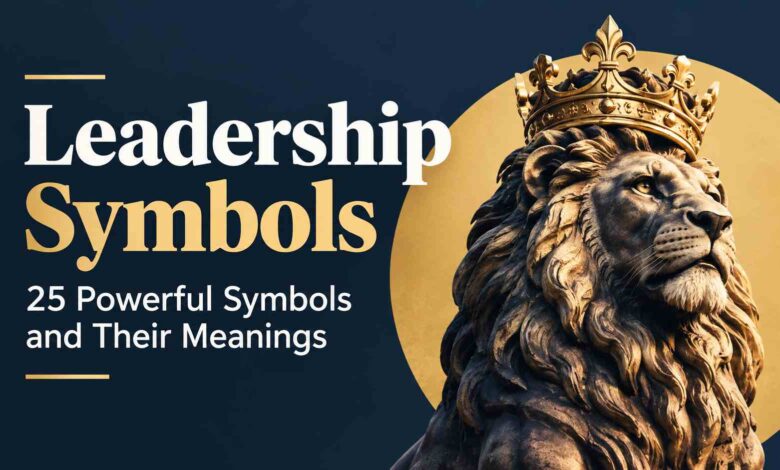
Leadership symbols have helped people communicate authority, courage, responsibility, direction, and wisdom for thousands of years. A crown can suggest sovereignty, a compass can represent direction, and an open hand can communicate service and support. Leadership symbols give visual form to qualities that are otherwise difficult to see.
Some symbols come from royal traditions, military insignia, mythology, religion, nature, or everyday objects. Their meanings can also change depending on the culture and context.
In this guide, you’ll discover 25 leadership symbols and their meanings, including classic symbols such as the crown and lion, as well as less obvious choices such as the bridge, oak tree, torch, and compass.
What Are Leadership Symbols?
Leadership symbols are images, objects, animals, or visual motifs associated with authority, guidance, responsibility, courage, wisdom, service, or influence.
They can appear in many forms:
- Royal objects such as crowns and scepters
- Animals such as lions and eagles
- Natural elements such as trees and mountains
- Tools such as compasses and torches
- Gestures such as open hands
- Clothing and insignia connected with rank
- Symbols used in organizations, schools, military traditions, and corporate identities
The meaning is not always universal. A dragon, for example, can represent imperial authority in Chinese art, while dragons in European traditions have often been portrayed differently. The surrounding culture matters.
Historically, leadership symbols also helped make social roles visible. A crown or ceremonial staff could communicate status without requiring a written explanation. In modern life, uniforms, badges, logos, and professional symbols can serve a similar identifying function.
25 Leadership Symbols and Their Meanings
Here is a quick overview before looking at each symbol in more detail:
| Symbol | Common leadership meaning |
|---|---|
| Crown | Authority and sovereignty |
| Lion | Courage and strength |
| Eagle | Vision and perspective |
| Compass | Direction and guidance |
| Torch | Knowledge and inspiration |
| Scepter | Formal authority |
| Laurel Wreath | Achievement and recognition |
| Oak Tree | Stability and endurance |
| Mountain | Strength and perseverance |
| Bridge | Connection and service |
| Open Hand | Generosity and support |
| Star | Guidance and aspiration |
| Shield | Protection and responsibility |
| Key | Trust and access |
| Rudder | Direction and control |
| Elephant | Wisdom and steadiness |
| Wolf | Loyalty and coordinated leadership |
| Dragon | Power and authority |
| Phoenix | Renewal and resilience |
| Beehive | Cooperation and organization |
| Anchor | Stability and reliability |
| Staff | Guidance and responsibility |
| Circle | Unity and continuity |
| Helm | Command and navigation |
| Falcon | Focus and decisiveness |
1. The Crown — Authority and Sovereignty
The crown is one of the most recognizable leadership symbols in history.
Its strongest associations are sovereignty, rank, legitimacy, and royal authority. Crowns have been used in many monarchic traditions to visually distinguish rulers from other members of society.
The important idea behind the crown is not simply wealth. It represents an office or position that carries authority. In ceremonial settings, the object can symbolize the continuity of a role even when the individual holding that role changes.
Today, crown imagery is also common in branding, sports, fiction, jewelry, and personal artwork. In these settings, it can suggest achievement, confidence, self-mastery, or status rather than literal political authority.
2. The Lion — Courage and Strength
The lion is frequently associated with leadership because of its long history in heraldry, royal imagery, mythology, and national symbolism.
It commonly represents:
- Courage
- Strength
- Confidence
- Protection
- Determination
A lion works particularly well as a leadership symbol because its visual presence is immediately recognizable. A lion on a shield, crest, or emblem can communicate power without needing words.
However, the meaning should not be treated as universal. Different cultures have developed their own relationships with lions, and modern uses may emphasize anything from bravery to prestige.
3. The Eagle — Vision and Perspective
The eagle is another powerful symbol connected with leadership, particularly vision, freedom, strength, and elevated perspective.
Because an eagle flies high above the ground, it is often used metaphorically for seeing the larger picture rather than becoming trapped in immediate problems.
Eagle imagery has appeared in imperial, national, military, and organizational contexts. Its meaning can therefore range from authority and sovereignty to independence and ambition.
As a leadership symbol, the eagle is especially suited to the idea of seeing beyond the immediate situation.
4. The Compass — Direction and Guidance
A compass represents one of the most practical qualities of leadership: knowing where you are going.
Unlike a crown, the compass does not primarily communicate rank. Instead, it suggests:
- Direction
- Purpose
- Orientation
- Decision-making
- Guidance
That makes it particularly relevant to modern ideas of leadership.
A leader does not necessarily have every answer. Good direction can sometimes mean understanding the destination, recognizing current circumstances, and adjusting the route when conditions change.
For that reason, compass imagery is common in leadership programs, education, personal development, business branding, and motivational artwork.
5. The Torch — Knowledge and Inspiration
The torch symbolizes light carried into darkness.
Its leadership meaning is closely connected with knowledge, education, hope, inspiration, and the sharing of understanding.
A torch is especially appropriate for teachers, mentors, coaches, and leaders whose influence comes from helping other people see possibilities more clearly.
The image of passing a flame from one person to another also creates a useful leadership metaphor: knowledge and responsibility can be transferred rather than permanently possessed by one person.
6. The Scepter — Formal Authority
The scepter is a ceremonial staff associated with rulers and formal authority.
Unlike an ordinary walking staff, a scepter exists primarily as a symbol. Its purpose is to communicate the status of the person holding it.
Its common meanings include:
- Authority
- Sovereignty
- Command
- Rank
- Institutional power
The scepter is therefore useful when discussing formal leadership, especially leadership connected with established institutions or traditions.
7. The Laurel Wreath — Achievement and Recognition
The laurel wreath has strong associations with victory, accomplishment, and honor in ancient Greek and Roman traditions.
Unlike inherited symbols of rank, the laurel is particularly interesting because it can represent achievement that has been earned.
That makes it a natural symbol for:
- Academic achievement
- Competition
- Excellence
- Recognition
- Accomplishment
Its continued appearance in educational and ceremonial imagery reflects this association with distinction and achievement.
8. The Oak Tree — Stability and Endurance
The oak tree is a natural symbol of long-term strength.
Its deep roots suggest stability, while its large branches can represent protection, growth, and the ability to provide support for others.
As a leadership symbol, the oak can represent:
Strength + patience + stability + growth
It is particularly suitable for leadership that focuses on building something that lasts rather than producing immediate results.
The oak also works well as a symbol of mentorship because a mature tree can provide shelter while continuing to grow itself.
9. The Mountain — Perseverance and Vision
A mountain represents obstacles, endurance, perspective, and achievement.
Leadership often involves difficult decisions and long-term challenges, which makes the mountain an effective metaphor for persistence.
From the top of a mountain, the surrounding landscape can be seen more clearly. Symbolically, this can represent a leader who steps back from immediate problems to understand the wider situation.
A mountain therefore communicates both resilience and perspective.
10. The Bridge — Connection and Service
The bridge represents connection.
It links places that would otherwise be separated, making it a useful symbol for leaders who bring different people, teams, or ideas together.
A bridge can represent:
- Collaboration
- Communication
- Service
- Unity
- Problem-solving
- Cooperation
This is particularly relevant to servant leadership, where influence is understood partly through helping others succeed.
A bridge does not need to stand in the spotlight to be useful. Its value comes from making movement possible for everyone else.
If you enjoy exploring meaningful symbols, continue with [ Spiritual Symbols and Meanings: 119 Powerful Symbols Explained] for another collection of powerful ideas.
11. The Open Hand — Generosity and Support
An open hand communicates something very different from a clenched fist.
It can suggest giving, welcoming, cooperation, assistance, and openness.
As a leadership symbol, the open hand is particularly useful for representing leadership based on support rather than control.
It can also represent the willingness to share knowledge, resources, opportunities, or responsibility with others.
Because hand gestures vary across cultures, the precise meaning of an open hand should always be considered in context.
12. The Shield — Protection and Responsibility
The shield is traditionally connected with protection.
In leadership symbolism, it can represent the responsibility to safeguard a group, uphold values, and stand between others and danger or difficulty.
Shield imagery is common in heraldry, institutional emblems, sports identities, and military traditions.
Its deeper leadership message is less about domination and more about responsibility for the people or principles represented by the shield.
13. The Star — Guidance and Aspiration
Stars have long been associated with guidance because they can help people orient themselves across the night sky.
That makes the star a natural symbol for:
- Vision
- Hope
- Direction
- Aspiration
- Achievement
A single star can suggest an individual goal, while multiple stars may represent a wider community or hierarchy.
In leadership contexts, the star often works as a metaphor for having something meaningful to guide decisions toward.
14. The Key — Trust and Responsibility
A key represents access.
Whoever possesses a key has permission to enter, unlock, protect, or control something valuable. This makes it an interesting leadership symbol because leadership often involves being trusted with information, resources, decisions, or opportunities.
The key can therefore symbolize:
Trust, access, responsibility, authority, and opportunity.
It is particularly effective when leadership is being discussed as stewardship rather than status.
15. The Rudder — Direction and Control
A rudder helps steer a vessel.
As a leadership metaphor, it represents the ability to influence direction while navigating changing conditions.
The rudder is different from the compass. A compass helps establish orientation, while a rudder represents the mechanism used to change or maintain direction.
Together, they make a useful leadership metaphor:
- Compass = Where should we go?
- Rudder = How do we steer toward it?
16. The Elephant — Wisdom and Steadiness
The elephant is commonly associated with strength, memory, patience, and wisdom in various cultural contexts.
As a leadership symbol, it can represent calm authority rather than aggressive power.
An elephant can therefore be a useful symbol for leaders who emphasize experience, stability, patience, and thoughtful decision-making.
Its meaning varies considerably across cultures, so it is better understood as a broad symbolic association than a universal definition.
17. The Wolf — Loyalty and Coordinated Leadership
The wolf is frequently used in symbolism involving loyalty, group cooperation, independence, and survival.
Its association with a pack makes it particularly interesting for leadership discussions. Rather than representing a solitary ruler, the wolf can symbolize leadership within a social group.
This makes it suitable for themes such as:
- Teamwork
- Loyalty
- Cooperation
- Group responsibility
- Strategic coordination
The wolf can therefore represent a model of leadership in which individual ability matters, but the group remains essential.
18. The Dragon — Power and Imperial Authority
The dragon has some of the clearest examples of how cultural context can dramatically change a symbol’s meaning.
In Chinese art, dragons have been associated with imperial authority and positive forces. The Metropolitan Museum of Art notes that dragon imagery could signify imperial power and benevolence, while five-clawed dragons were strongly associated with the emperor in particular historical contexts.
Imperial robes also used highly regulated dragon imagery connected with the emperor and court hierarchy.
So, when using the dragon as a leadership symbol, it is important to avoid treating all dragon traditions as identical.
19. The Phoenix — Renewal and Resilience
The phoenix is commonly associated with renewal, transformation, and rising again after destruction.
That makes it especially relevant to leadership during periods of change.
A phoenix can represent a leader or organization that responds to setbacks by rebuilding rather than remaining defined by the past.
Its strongest leadership themes are:
- Renewal
- Transformation
- Resilience
- Reinvention
- New beginnings
Unlike the crown, the phoenix is not primarily about rank. Its symbolism is about what happens after a major transition.
20. The Beehive — Cooperation and Organization
A beehive represents coordinated collective activity.
It can symbolize a group in which individual contributions support a larger purpose. For leadership, this makes the beehive useful for discussing teamwork, organization, productivity, and shared responsibility.
The metaphor should not be taken to mean that every organization needs identical roles or behavior. Its useful point is simpler: large achievements often depend on coordinated contributions from many people.
21. The Anchor — Stability and Reliability
An anchor keeps a vessel from drifting.
As a leadership symbol, it can represent:
- Stability
- Reliability
- Grounding
- Commitment
- Consistency
The anchor is particularly fitting for leadership during uncertain periods. It represents the qualities that help a group remain connected to its values while circumstances change.
22. The Staff — Guidance and Responsibility
A staff has practical origins as a tool for walking and traveling, but it has also acquired ceremonial meanings in many traditions.
As a leadership symbol, it can represent guidance, support, responsibility, and authority.
The shepherd’s staff provides a particularly familiar metaphor: leadership is not only about directing people but also about helping them navigate difficult ground.
23. The Circle — Unity and Continuity
The circle can represent unity, wholeness, continuity, and equality.
Unlike a pyramid or hierarchy, a circle has no obvious top or bottom. This makes it particularly useful for modern leadership concepts centered on collaboration and shared participation.
A circle can therefore symbolize leadership that creates connection rather than simply emphasizing rank.
24. The Helm — Command and Navigation
A helm is strongly associated with steering a ship.
That gives it a natural connection to leadership: someone at the helm is responsible for helping determine the vessel’s direction.
The symbol can represent:
- Responsibility
- Navigation
- Decision-making
- Control
- Direction
The important idea is that being at the helm does not mean controlling every part of the journey. It means accepting responsibility for steering.
25. The Falcon — Focus and Decisiveness
The falcon can represent speed, focus, precision, and controlled action.
Its symbolism works particularly well for leadership that requires concentration and timely decisions.
Compared with the broader perspective associated with an eagle, the falcon can be used to emphasize focused attention and precise action.
Leadership Symbols in Different Cultures
Leadership symbolism has never followed one universal system.
Different societies have used different objects and animals to communicate authority, legitimacy, protection, wisdom, and responsibility.
| Tradition or context | Examples | Common themes |
|---|---|---|
| Ancient Egypt | Crook, flail, royal crowns | Rule, protection, authority |
| Ancient Greece | Laurel, staff, symbols of victory | Achievement, honor, guidance |
| Ancient Rome | Eagle, laurel, fasces | Military power, office, authority |
| Imperial China | Dragon, imperial robes | Imperial authority, cosmic order |
| Medieval Europe | Crowns, shields, coats of arms | Rank, identity, sovereignty |
| Modern institutions | Badges, uniforms, stars, seals | Rank, responsibility, role |
Historical symbols can also change meaning. The Roman fasces, for example, was associated with magistrates and authority in ancient Rome but was later appropriated by Italian Fascism. This is a useful reminder that a symbol’s meaning depends partly on who uses it, when, and in what setting.
Leadership Symbols for Different Leadership Qualities
If you are choosing a symbol for a personal project, logo, tattoo concept, character, organization, or piece of artwork, start with the quality you want it to communicate.
| Leadership quality | Symbols that can express it |
|---|---|
| Authority | Crown, scepter, shield |
| Courage | Lion, falcon |
| Vision | Eagle, star, compass |
| Guidance | Compass, staff, torch |
| Wisdom | Elephant, oak tree |
| Stability | Anchor, oak tree, mountain |
| Service | Open hand, bridge, shepherd’s staff |
| Achievement | Laurel wreath, star |
| Resilience | Phoenix, mountain |
| Teamwork | Beehive, bridge, wolf |
| Direction | Compass, rudder, helm |
| Protection | Shield, lion |
These associations are useful starting points rather than strict rules. A symbol can communicate something different when placed in a particular cultural, historical, religious, or organizational context.
What Makes a Leadership Symbol Effective?
A strong leadership symbol usually works because its visual meaning can be understood quickly.
Three qualities are especially useful:
1. Recognition
The symbol should be visually distinctive enough that people can identify it without extensive explanation.
2. Association
It should connect naturally with the quality being represented. A compass makes an intuitive connection with direction; a shield makes one with protection.
3. Context
The same image can mean different things in different cultures. Researching the background of a symbol is important before using it commercially, ceremonially, or personally.
This is especially important with historical and religious imagery, where modern interpretations may differ from the original meaning.
Leadership Symbols in Logos and Modern Design
Leadership symbolism has moved far beyond crowns and royal courts.
Modern organizations often use visual elements that communicate qualities such as reliability, innovation, expertise, stability, or authority. Shields, stars, mountains, animals, geometric forms, and directional imagery can all appear in institutional branding.
The key difference is that modern leadership branding usually focuses less on who has inherited power and more on what an organization wants to be associated with.
For example:
- A shield can suggest protection or trust.
- A mountain can suggest ambition and endurance.
- A compass can suggest direction.
- A torch can suggest knowledge.
- An oak tree can suggest stability.
- A bridge can suggest connection.
The most effective choice depends on the audience, industry, cultural setting, and message.
FAQs About Leadership Symbols
What is the most common symbol of leadership?
The crown is one of the most widely recognized traditional symbols of leadership because it has a long association with monarchy, sovereignty, and formal authority. Other symbols, including the lion, eagle, compass, and torch, communicate different forms of leadership.
What animal represents leadership?
There is no single universal leadership animal. Lions, eagles, elephants, wolves, and falcons are commonly used in leadership symbolism, but their meanings vary by culture and context.
What symbol represents a good leader?
Symbols such as the compass, open hand, oak tree, bridge, and torch can represent different qualities associated with leadership, including guidance, service, stability, connection, and knowledge.
What symbol represents strong leadership?
A lion, shield, mountain, or oak tree can communicate strength, but the appropriate choice depends on what kind of strength you mean. Physical power, emotional resilience, stability, and protective responsibility are different ideas.
What flower represents leadership?
The laurel is historically connected with victory, honor, and achievement and is therefore one of the strongest traditional plant symbols associated with distinction and accomplishment.
What represents servant leadership?
An open hand, bridge, shepherd’s staff, or oak tree can work as a metaphor for servant leadership because each can represent support, guidance, connection, or providing conditions for others to grow.
Why are animals used as leadership symbols?
Animals provide recognizable qualities that people can use metaphorically. Lions may suggest courage, eagles perspective, and elephants steadiness, for example. These meanings are cultural associations rather than fixed scientific definitions.
Conclusion
Leadership symbols turn abstract qualities into recognizable images.
A crown can communicate authority, a compass can suggest direction, a lion can represent courage, an open hand can express service, and an oak tree can symbolize stability. Others, such as the phoenix, bridge, torch, and mountain, offer different ways to think about resilience, connection, knowledge, and perseverance.
The most important point is that symbols do not have one permanent meaning everywhere. Their interpretation depends on history, culture, context, and the way they are presented.
That flexibility is what makes leadership symbols so useful. Whether you are researching history, choosing an emblem, developing a character, creating a logo concept, or simply exploring symbolism, the right image can communicate an entire leadership philosophy at a glance.