Voodoo symbols are often surrounded by mystery, especially in movies and popular culture. But the symbols associated with Haitian Vodou and related traditions have a much deeper cultural and religious history.
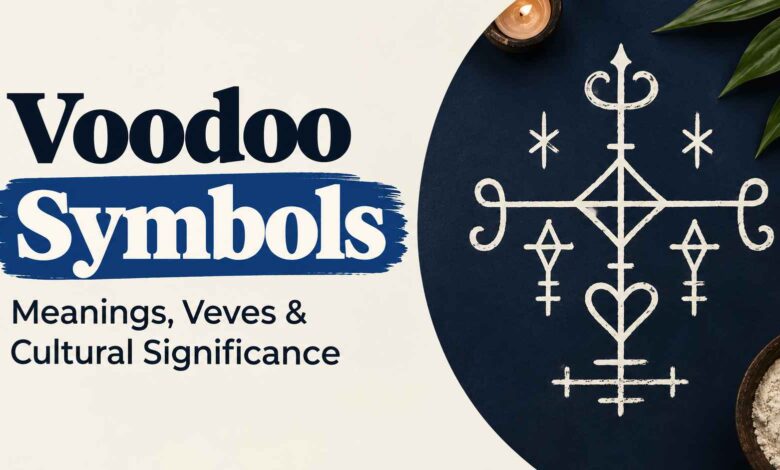
Many of the best-known sacred drawings are called veves. In Haitian Vodou, a veve is a ritual design associated with a particular Lwa, or spiritual being. These designs can represent ideas such as guidance, love, protection, strength, wisdom, transformation, and spiritual connection.
Understanding Voodoo symbols requires looking beyond fictional portrayals of curses, magic, and horror. Their meanings depend on the tradition, community, Lwa, ceremony, and context in which they are used.
What Are Voodoo Symbols?
Voodoo symbols generally refers to symbolic imagery associated with Vodou, Voodoo, and related spiritual traditions. However, the term can cover different traditions, so it is important not to treat every symbol as belonging to one single belief system.
In Haitian Vodou, one of the most recognizable forms of sacred symbolism is the veve.
A veve is a carefully created ritual drawing that represents a particular Lwa. Traditionally, veves may be drawn using materials such as flour, cornmeal, chalk, or other powders during ceremonies.
These designs can contain:
- Lines and geometric shapes
- Circles and curves
- Crossroads
- Hearts
- Serpentine forms
- Keys and other symbolic objects
- Other elements associated with a particular Lwa
A veve is therefore more than decorative artwork. Within its religious context, it can function as an important part of ceremony and spiritual expression.
Voodoo Symbols and Their Meanings
The meaning of a Voodoo symbol depends heavily on its cultural and religious context.
Some symbols are associated with particular Lwa, while other imagery may communicate broader themes such as love, protection, wisdom, courage, death, transformation, or guidance.
It is also important to remember that popular culture sometimes gives these symbols meanings that differ significantly from how practitioners understand them.
Here are some of the best-known examples associated with Haitian Vodou.
1. Papa Legba Veve
The Papa Legba veve is associated with Papa Legba, an important Lwa in Haitian Vodou.
Papa Legba is traditionally associated with crossroads, communication, access, and the relationship between the human and spiritual worlds.
His symbolism is often connected with doors, paths, keys, and crossroads. The source material describes his veve as commonly featuring imagery such as a crossroads, keys, and a walking stick.
What does Papa Legba symbolize?
Papa Legba is commonly associated with:
- Guidance
- Communication
- Choices
- Crossroads
- Access to the spiritual world
- Opening paths
The crossroads are especially meaningful because they can represent decisions and different directions in life.
2. Erzulie Freda Veve
The Erzulie Freda veve is associated with Erzulie Freda, an Lwa connected with love, beauty, affection, and related qualities.
Her veve is particularly recognizable for its heart-shaped imagery and decorative curves.
Erzulie Freda symbolism
Her symbolism can be associated with:
- Love
- Beauty
- Compassion
- Joy
- Generosity
- Harmony
- Emotional connection
Because of these associations, heart imagery connected with Erzulie Freda is sometimes recognized as an important part of Vodou-inspired symbolism.
3. Baron Samedi Veve
The Baron Samedi veve is one of the most recognizable forms of Vodou-related imagery.
Baron Samedi is strongly associated with death, the ancestors, transformation, and the boundary between life and death.
His imagery can include crosses and other motifs associated with mortality and remembrance.
What does Baron Samedi symbolize?
Common associations include:
- Death
- Transformation
- Rebirth
- Ancestors
- Remembrance
- The cycle of life
Popular entertainment often portrays Baron Samedi as a frightening figure. However, reducing his symbolism to horror misses the broader religious context surrounding death and remembrance.
4. Damballa Veve
The Damballa veve is commonly associated with serpent imagery.
Damballa is an important Lwa in Haitian Vodou, and serpent symbolism associated with Damballa can represent themes such as creation, wisdom, life, peace, and spiritual power.
The intertwined serpent design is especially recognizable.
[ Symbols to Represent Yourself: 35 Powerful Ideas]
Damballa symbolism
It can be connected with:
- Creation
- Wisdom
- Peace
- Life
- Purity
- Spiritual development
- Ancestral connection
This is one reason serpent imagery should not automatically be interpreted as a symbol of evil when discussing Vodou.
5. Ogou Veve
The Ogou veve is associated with Ogou, an Lwa commonly connected with strength, courage, protection, leadership, and determination.
Its imagery may include sword- or weapon-like forms and strong geometric lines.
What does Ogou symbolize?
Ogou symbolism is commonly associated with:
- Courage
- Strength
- Leadership
- Protection
- Justice
- Determination
- Perseverance
The emphasis is not simply on physical power. Ogou symbolism can also represent responsible use of strength and courage.
6. Crossroads Symbolism
The crossroads is an important motif in Haitian Vodou symbolism, particularly through its association with Papa Legba.
A crossroads naturally represents a meeting point between different paths. Symbolically, this can relate to:
- Choices
- Decisions
- Change
- New opportunities
- Different life directions
- Communication between worlds
Because crossroads have meaning in many cultures, their presence alone does not necessarily identify an image as a Vodou veve.
7. Serpent Symbolism
Serpent imagery has an important place in some Vodou traditions, particularly in symbolism associated with Damballa.
In this context, the serpent can represent ideas such as creation, wisdom, life, balance, and spiritual power rather than the simplistic idea of evil sometimes presented in popular media.
This is a good example of why symbolic meaning should be interpreted within its cultural setting.
8. Heart Symbolism
Heart imagery is strongly associated with Erzulie Freda.
The heart can communicate themes of:
- Love
- Beauty
- Affection
- Compassion
- Harmony
- Emotional connection
However, a heart by itself is not automatically a traditional Vodou symbol. Its meaning depends on how it appears within a particular veve and religious context.
9. Key Symbolism
Keys are commonly associated with Papa Legba in representations of his symbolism.
A key naturally suggests ideas such as:
- Opening
- Access
- Doors
- Knowledge
- Communication
- Passage
Within Vodou symbolism, the key can take on a deeper meaning because of Papa Legba’s role and associations.
10. Cross Symbolism
Cross imagery appears in some Vodou-related symbolism, but it should not automatically be interpreted as a symbol of one specific Lwa.
Haitian Vodou developed through a complex history involving African religious traditions and other cultural and religious influences. Consequently, some visual elements can have overlapping meanings across traditions.
The meaning of a cross therefore depends on the specific symbol, ceremony, and context in which it appears.
Haitian Vodou Symbols vs. Popular “Voodoo” Imagery
One of the biggest problems when researching Voodoo symbols is that popular culture often mixes together different traditions.
Haitian Vodou has historical connections to West and Central African religious traditions, along with influences that developed in Haiti. West African Vodun traditions are also important in understanding the broader history of these religious systems.
Louisiana Voodoo developed in a different historical and cultural environment, including African, Caribbean, European, and Catholic influences.
Because of this history, it is inaccurate to assume that every symbol seen in a movie, tattoo, video game, or online image belongs to Haitian Vodou.
What Are Veves in Haitian Vodou?
Veves are sacred ritual drawings associated with particular Lwa in Haitian Vodou.
They are generally created as part of religious ceremonies and are not simply decorative designs.
Different veves can have different forms depending on the Lwa they represent. Some may use geometric shapes, while others contain recognizable imagery connected with the spirit.
The source material describes veves as drawings made before ceremonies and notes that each is associated with a particular Lwa and role.
This makes the context behind a symbol just as important as its appearance.
Are Voodoo Symbols Evil?
No, it is not accurate to describe all Voodoo or Vodou symbols as evil.
The word “Voodoo” has frequently been associated with horror stories, curses, and supernatural stereotypes in Western entertainment. Those portrayals do not provide a complete description of Haitian Vodou or its symbolism.
Within Haitian Vodou, sacred symbols can be associated with prayer, spiritual relationships, guidance, healing, protection, love, community, and reverence.
That does not mean every symbol has a universally positive meaning. Rather, its meaning should be understood within the specific religious and cultural tradition where it is used.
Voodoo Symbols for Protection
Protection is one theme commonly discussed when people search for Voodoo protection symbols.
However, there is no single universal “Voodoo protection symbol.” Different Lwa, veves, rituals, and traditions have different meanings.
Protection-related symbolism may involve ideas such as:
- Strength
- Spiritual guidance
- Safety
- Courage
- Faith
- Community
- Respect for ancestors
It is better to identify the specific tradition and symbol instead of treating all protective imagery as interchangeable.
Voodoo Symbols for Love
When people search for Voodoo symbols for love, Erzulie Freda is one of the most relevant figures in Haitian Vodou.
Her symbolism is associated with love, beauty, affection, generosity, and harmony. Her veve is particularly recognized for heart imagery.
However, these symbols should not be presented as tools for controlling another person’s feelings. Their religious meaning is better understood through themes of affection, relationships, compassion, and emotional connection.
Voodoo Symbols for Death and Transformation
Death symbolism is particularly associated with Baron Samedi and related Gede traditions.
Rather than representing only fear, death-related symbolism can involve:
- Remembrance
- Ancestors
- Mortality
- Transformation
- The cycle of life
- Continuity between generations
This is another area where entertainment stereotypes can obscure the cultural meaning of the symbols.
African Roots of Vodou Symbolism
The history of Vodou cannot be separated from African religious traditions.
West African Vodun traditions, particularly those associated with regions including present-day Benin and Togo, are part of the broader historical background of Haitian Vodou.
As traditions developed through migration, cultural exchange, and historical circumstances, religious practices and symbolism changed as well.
That is why it is more accurate to talk about interconnected traditions and historical development than to treat “Voodoo” as one simple system with one fixed collection of symbols.
Louisiana and New Orleans Voodoo Symbols
Louisiana Voodoo and New Orleans Voodoo have their own historical development and should not simply be treated as identical to Haitian Vodou.
The traditions developed in different environments and incorporated different cultural influences.
New Orleans is also associated with historical figures such as Marie Laveau, whose legacy has become closely connected with popular discussions of Voodoo in the city.
When researching a particular symbol, always check whether it comes from Haitian Vodou, Louisiana Voodoo, West African Vodun, modern spiritual art, or popular culture.
Why Are Voodoo Symbols So Fascinating?
Symbols communicate complex ideas without requiring many words.
Voodoo and Vodou imagery attracts attention because of its:
- Geometric designs
- Historical depth
- Religious symbolism
- Connection to spiritual traditions
- Distinctive visual patterns
- Stories associated with different Lwa
But their visual appeal should not be separated from their cultural significance.
A veve is not simply a mysterious design for decoration. For practitioners, it can represent a religious relationship and a living tradition passed through generations.
How to Understand Voodoo Symbols Respectfully
If you’re researching Voodoo symbols for education, history, art, or cultural interest, context matters.
Keep these points in mind:
- Learn the specific tradition. Haitian Vodou, Louisiana Voodoo, and West African Vodun are not interchangeable.
- Identify the Lwa when possible. A veve generally has a specific religious association.
- Avoid movie stereotypes. Fiction often presents simplified versions of these traditions.
- Don’t treat sacred designs as generic decoration. Their religious significance matters.
- Check reliable historical sources. Online symbol lists can mix authentic traditions with modern inventions.
- Consider the community behind the tradition. Understanding how practitioners view their symbols provides better context.
Frequently Asked Questions
What are Voodoo symbols?
Voodoo symbols are visual signs, designs, and sacred imagery associated with Vodou, Voodoo, and related spiritual traditions. In Haitian Vodou, veves are important ritual drawings associated with particular Lwa.
What is a veve?
A veve is a sacred ritual drawing used in Haitian Vodou and associated with a particular Lwa. Veves can contain geometric shapes and imagery that identify or represent the spiritual being.
What is the most famous Voodoo symbol?
There is no single universally recognized “most famous” Voodoo symbol. Papa Legba, Erzulie Freda, Baron Samedi, Damballa, and Ogou are among the well-known figures represented through Haitian Vodou symbolism.
What does the Papa Legba symbol mean?
Papa Legba symbolism is associated with crossroads, communication, guidance, access, and paths between different realms.
What does the Damballa symbol mean?
Damballa symbolism is commonly associated with serpent imagery and themes including creation, wisdom, peace, life, and spiritual power.
What does the Erzulie Freda symbol mean?
Erzulie Freda symbolism is associated with love, beauty, compassion, generosity, joy, and harmony. Her veve is particularly recognized for heart imagery.
Are Voodoo symbols evil?
Voodoo symbols should not automatically be described as evil. Their meanings depend on the specific tradition and context, and many are associated with prayer, guidance, love, protection, ancestors, and spiritual relationships.
What are Haitian Voodoo symbols called?
Many of the sacred ritual drawings used in Haitian Vodou are called veves. Each veve is generally associated with a particular Lwa.
What is the difference between Vodou and Voodoo?
Vodou commonly refers to the Haitian religious tradition, while Voodoo is a broader English spelling that is also used for different traditions, especially in popular culture. Louisiana Voodoo is historically distinct from Haitian Vodou.
Conclusion
Voodoo symbols have a much richer history than the stereotypes often shown in movies and popular entertainment.
In Haitian Vodou, veves are sacred ritual drawings connected with specific Lwa. Symbols associated with Papa Legba, Erzulie Freda, Baron Samedi, Damballa, and Ogou can communicate ideas involving guidance, love, transformation, wisdom, courage, protection, and spiritual connection.
The most important point is that these symbols should be understood within their cultural and religious context. A symbol that looks mysterious or frightening from the outside may carry a completely different meaning for the people and traditions connected to it.
Learning the history behind these designs makes them more meaningful than simply treating them as mysterious or decorative images.