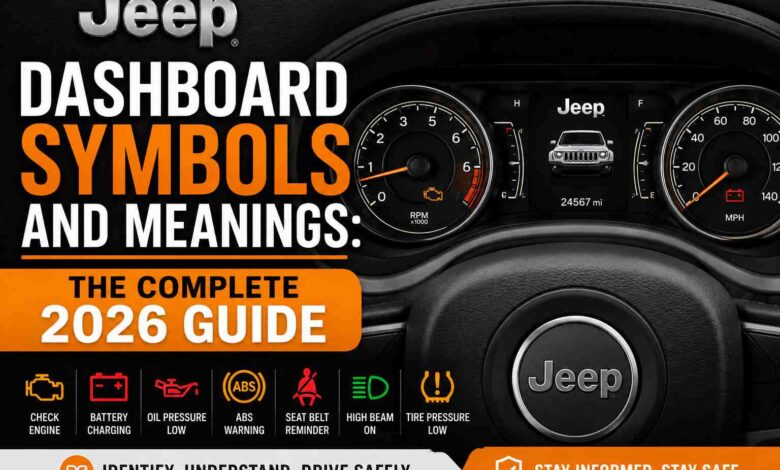
A light just came on behind your steering wheel, and your first thought is probably somewhere between “is this serious?” and “can I still make it home?” That split-second uncertainty is exactly why understanding Jeep dashboard symbols and meanings matters — these icons are your Jeep’s only way of telling you something before it becomes an expensive problem.
This guide walks through every major warning light, indicator, and reminder across Wrangler, Grand Cherokee, Compass, Cherokee, and Gladiator models — what each one looks like, what it’s actually telling you, and what to do the moment it appears.
Jeep Dashboard Warning Light Colors: What They Mean at a Glance
Before memorizing individual icons, learn the color system. It’s the fastest way to judge urgency without even knowing the specific symbol:
| Color | Urgency | What It Signals | What To Do |
|---|---|---|---|
| 🔴 Red | Critical | Safety or engine damage risk | Pull over and stop driving |
| 🟡 Amber/Yellow | Caution | A system needs attention | Get it checked within a few days |
| 🟢 Green | Informational | A feature is on and working | No action needed |
| 🔵 Blue | Informational | A feature is currently active | No action needed |
| ⚪ White | Reminder | Minor notice or status update | Note it, address when convenient |
The one rule worth memorizing above all others: a red light means stop driving as soon as it’s safe to do so. Amber can usually wait a few days. Red generally can’t.
Red Jeep Dashboard Symbols You Should Never Ignore
These are the warning symbols tied to real safety or mechanical risk.
- Oil pressure warning (oil can icon): Oil pressure has dropped to an unsafe level. Pull over, shut off the engine, and check your oil level before driving any further — continuing to drive on low oil pressure risks serious engine damage.
- Engine temperature warning (thermometer icon): The engine is overheating. Stop, turn off the engine, and let it cool completely before checking coolant. Never open a hot radiator cap — pressurized coolant can cause burns.
- Battery/charging warning: The alternator isn’t charging the battery properly. Cut non-essential electronics and get to a shop before the vehicle loses power entirely.
- Brake warning light: Often just means your parking brake is engaged. If it stays lit with the parking brake off, treat it as a brake fluid or brake system issue and stop driving.
- Airbag/SRS warning: The airbag system has a fault, which can mean airbags won’t deploy correctly in a crash. This isn’t one to put off.
- Door ajar light: A door, hood, or tailgate isn’t fully latched. Usually simple to fix, but confirm everything’s closed before continuing.
A flashing check engine light is a special case. A steady amber check engine light usually means a minor fault — you can drive cautiously and get it diagnosed soon. A flashing light means an active engine misfire, which can damage your catalytic converter within minutes of continued driving.
Amber/Yellow Jeep Dashboard Symbols: Get It Checked Soon
These indicate a real issue, but not one that typically requires pulling over immediately.
- Tire Pressure Monitoring System (TPMS): A horseshoe-shaped icon meaning at least one tire’s pressure is outside the recommended range. This is especially common on Wranglers after off-road driving, since many owners deliberately air down their tires for better traction and forget to reinflate afterward. Cold weather alone can also trigger it, since tire pressure drops as temperatures fall.
- Traction control / Electronic Stability Control (ESC): Flashing means the system is actively correcting wheel slip — normal in rain, snow, or loose terrain. Steady means the system has been switched off or has a fault.
- ABS warning light: Your regular brakes still work, but anti-lock braking — which keeps you steering during hard braking — isn’t functioning. Drive with more following distance until it’s repaired.
- Low fuel light: Usually triggers with roughly a quarter tank or less remaining, depending on the model. Running the tank fully dry repeatedly can shorten fuel pump life.
- Loose gas cap warning: A surprisingly common trigger for both this light and the check engine light. Retighten the cap until it clicks; it may take a drive cycle or two to clear.
- Service/maintenance reminder (wrench icon): A scheduled maintenance interval — usually an oil change — has come up based on mileage or time elapsed.
Green and Blue Jeep Dashboard Symbols: Just Information
Not every light is a warning. These simply confirm a feature is on:
- 4WD engaged indicator — four-wheel drive is active; Wranglers and Gladiators typically show separate icons for 4WD High and 4WD Low
- Cruise control indicator — set speed is active
- High beam indicator — usually blue, confirms high beams are on
- Hill Descent Control — active on steep declines, common on Trailhawk and Rubicon trims
- Turn signal arrows — a signal flashing roughly twice its normal speed usually means a bulb has burned out
If dashboard confusion is a running theme for you, [Latest Article] covers another everyday symbol people misread constantly — worth a look while you’re troubleshooting.
Jeep-Specific Symbols You Won’t Find on Other Cars
A handful of icons are unique to Jeep’s off-road-focused lineup:
- Selec-Terrain mode indicator — shows which terrain mode (Rock, Sand, Snow, Auto) is currently selected, found on models equipped with the Selec-Terrain system
- Selec-Speed Control — maintains a controlled crawl speed on steep descents without the driver touching the brake, mainly on Wrangler and Gladiator Rubicon trims
- Auto Start-Stop indicator (the “A” icon) — a green “A” means the system that shuts off your engine at stoplights to save fuel is working; an amber “A” with an exclamation point means it’s temporarily disabled, often due to a weak battery or cold engine
- 4xe hybrid battery and charging icons — battery charge level, charging status, and electric-drive mode indicators specific to the Wrangler 4xe and Grand Cherokee 4xe plug-in hybrids
Jeep Dashboard Symbols by Model
Not every trim gets every symbol. Rock-crawling features, for instance, are mostly reserved for Rubicon and Trailhawk trims:
| Feature | Wrangler | Grand Cherokee | Compass | Gladiator |
|---|---|---|---|---|
| 4WD Indicator | Standard | Available | Select trims | Standard |
| Hill Descent Control | Rubicon | Trailhawk | Select trims | Rubicon |
| Selec-Terrain Modes | Rubicon | Trailhawk | Limited | Rubicon |
| Auto Start-Stop | 2018+ | Standard | Standard | Standard |
| 4xe Hybrid Symbols | 4xe only | 4xe only | Not available | Not available |
| Check Engine / TPMS | All trims | All trims | All trims | All trims |
Note: exact trim availability shifts by model year, so if you’re troubleshooting a specific icon that isn’t covered here, your owner’s manual (or the Jeep app, on newer models) is the most reliable source for your exact configuration.
What to Do When a Warning Light Comes On
A simple sequence to follow every time:
- Note the color first. Red means pull over when safe; amber means drive carefully and address it soon; green or blue needs no action.
- Check whether it’s steady or flashing. A flashing light is always more urgent — treat it as an immediate stop, especially for the check engine light.
- Rule out the obvious. Is the parking brake actually engaged? Is the gas cap tight? Are all doors closed? A large share of warning lights trace back to something this simple.
- Get a free OBD-II scan. Most auto parts stores will read your vehicle’s diagnostic code at no cost, telling you exactly what triggered the light instead of leaving you guessing.
- Fix the cause, don’t just clear the code. Resetting the light without repairing the issue only hides the symptom — it will resurface.
Common Myths About Jeep Dashboard Symbols
| Myth | Reality |
|---|---|
| “If it drives fine, I can ignore the check engine light” | Plenty of serious issues cause no noticeable change in how the vehicle drives — until they cause a bigger failure. |
| “TPMS light means a flat tire” | It usually just means pressure is outside the ideal range; the tire can look completely normal. |
| “A light that turns off on its own means the problem’s fixed” | Some lights cycle with conditions, but the fault code often stays stored even after the light goes dark. |
| “You need a dealership to read the codes” | Most auto parts stores will scan OBD-II codes for free — no dealership visit required. |
| “All Jeep models share the same dashboard symbols” | Base trims and off-road-oriented trims (Rubicon, Trailhawk) can have noticeably different symbol sets. |
Frequently Asked Questions
What does the “A” symbol with an exclamation mark mean on a Jeep?
It relates to the Auto Start-Stop system. A green “A” means the fuel-saving start-stop feature is working normally. An amber “A” with an exclamation point means the system has temporarily disabled itself — often due to a weak battery, cold engine, or the driver manually turning it off.
Can I keep driving with the check engine light on?
If it’s steady, generally yes for a short while, but get it diagnosed soon. If it’s flashing, no — that indicates an active misfire that can damage the catalytic converter with continued driving.
Why does my Jeep Wrangler’s TPMS light keep coming back on?
It’s frequently tied to off-roading, since many Wrangler owners intentionally lower tire pressure for better grip and don’t always reinflate fully afterward. Cold weather can also trigger it even on properly inflated tires, since pressure naturally drops as temperatures fall.
What’s the most serious symbol on a Jeep dashboard?
The oil pressure warning, the engine temperature warning, and a flashing check engine light are generally considered the most urgent — each is tied to a risk of significant engine damage if driving continues.
How do I reset a Jeep dashboard warning light?
Fix the underlying issue first. Most lights clear automatically after a few drive cycles once the problem is resolved. For TPMS, reinflate to the correct pressure and drive for a few minutes. Avoid disconnecting the battery just to clear a light — it wipes stored diagnostic data and can create other complications.
Is a green dashboard light ever something to worry about?
Not typically. Green almost always means a feature or system is simply switched on and functioning — it’s informational, not a warning.
Conclusion
Jeep dashboard symbols aren’t random — each one is a specific message about a specific system, and the color tells you how quickly to respond. Red means stop, amber means schedule a check, and green or blue just means a feature is doing its job. When you’re not sure what a symbol means, a free OBD-II scan at any auto parts store will tell you exactly what triggered it, rather than leaving you to guess.
Keep this guide handy, and the next time something lights up on your dash, you’ll know within seconds whether it’s a five-minute fix or a reason to pull over.
A quick honesty note: exact PSI figures, fuel-range thresholds, and trim availability can shift by model year, so always cross-check anything that affects a real driving decision against your specific owner’s manual or door-jamb sticker rather than relying solely on this or any general guide.