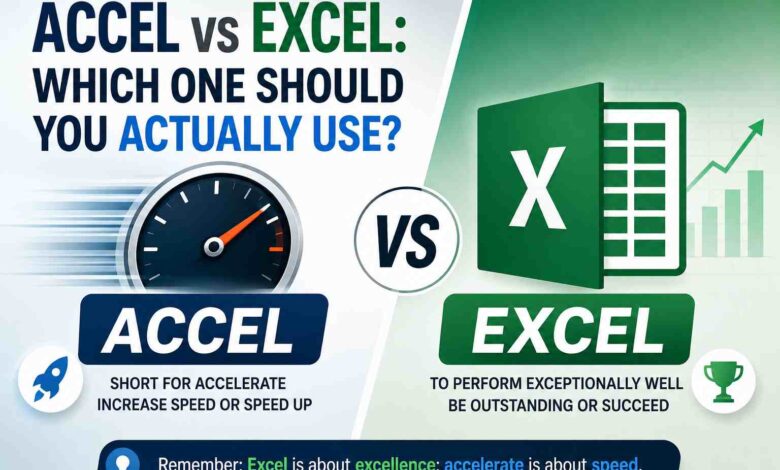
The Accel vs Excel mix-up is more common than you’d think. If you’ve ever typed “accel” into a sentence and then paused, wondering whether it’s even a real word, you’re not alone. Accel and Excel look almost identical, sound alike when you say them quickly, and autocorrect doesn’t always save you. Only one of them, though, is a standard English word you can use confidently in formal writing. This guide breaks down exactly what each word means, when each one is actually acceptable, and how to settle the Accel vs Excel confusion for good.
What Does “Excel” Mean?
Excel is a verb that means to do something exceptionally well, to be outstanding at a skill, task, or achievement. If you excel at something, you’re not just doing fine, you’re standing out from everyone else doing the same thing.
It comes from the Latin word excellere, meaning “to rise above” or “to surpass,” and that root meaning still shapes how the word is used today. You’ll see it constantly in academic and professional writing:
- “She excels at public speaking.”
- “Our sales team excelled this quarter.”
- “He’s always excelled in math.”
Note the spelling in past tense: excelled, with a doubled “l,” not “exceled.” That’s one of the most common spelling slip-ups tied to this word, right alongside the accel confusion.
What Does “Accel” Mean?
Accel is short for accelerate, meaning to increase speed, rate, or intensity. It’s informal shorthand, the kind you’ll run into in gaming chat, racing and automotive talk, programming shorthand (like an “accel” setting in a game engine or a car’s dashboard), or quick internal notes where nobody has time to type the full word.
It is not a standard, dictionary-recognized English word on its own. You won’t find “accel” used as a verb in a sentence like “I need to accel my progress,” at least not in anything that’s supposed to sound professional. In that context, the correct word is “accelerate.”
Why People Mix These Two Up
A few things collide to cause this confusion:
- They look alike on the page. Five letters, similar shape, easy to misread when skimming.
- Autocorrect doesn’t flag “accel.” Since it’s a legitimate abbreviation in some technical fields, spell-checkers often let it slide, even when the sentence actually needed “excel.”
- Brand association muddies things further. Microsoft Excel is such a dominant, everyday reference that “excel” sometimes gets typed on autopilot when someone actually means “speed up” or “accelerate.”
- Casual speech blurs the sound. Said out loud, especially quickly, “excel” and “accel” aren’t far apart.
Once you separate the two by meaning, though, the mix-up mostly disappears: excel = outstanding performance, accelerate = increased speed.
Excel vs Accel: Side-by-Side Comparison
| Excel | Accel | |
|---|---|---|
| Part of speech | Verb | Informal shorthand (for “accelerate”) |
| Meaning | To perform exceptionally well | To increase speed or intensity |
| Formal writing | Always acceptable | Avoid, use “accelerate” instead |
| Common context | Academic, professional, everyday achievement | Gaming, automotive, programming, casual notes |
| Example | “He excels at chess.” | “Hit the accel to pass the truck.” (casual/technical only) |
If spelling mix-ups like this one trip you up regularly, it’s worth checking [Latest Article] next, it covers another word pair people confuse just as often.
Is “Accel” Ever Actually Correct?
Yes, in the right setting. If you’re writing dialogue for a racing game, leaving a quick note to a teammate (“gonna accel through this section”), or working inside a codebase where “accel” is an established variable or setting name, it’s fine. Context and audience decide whether shorthand is acceptable, and in those specific spaces, it is.
Outside of that, in essays, emails to a client, resumes, reports, or anything meant to read as professional, “accel” doesn’t belong. Use “accelerate” instead, and save “excel” for describing excellence, not speed.
How to Use Each Word Correctly
Using Excel in a sentence:
- “Our team excelled under pressure during the product launch.”
- “Students who excel academically often develop strong study habits early.”
- “She’s determined to excel in her new role.”
Using Accelerate (not “accel”) in a sentence:
- “The company plans to accelerate its expansion into new markets.”
- “Press the pedal gently to accelerate on the highway.”
- “We need to accelerate the timeline for this project.”
A simple test: if the sentence is about being good at something, you want excel. If it’s about something getting faster, you want accelerate.
Common Mistakes to Avoid
- Wrong: “She wants to accel in her career this year.” Right: “She wants to excel in her career this year.” (The sentence is about performance and achievement, not speed, so “excel” is correct.)
- Wrong: “We need to excel the delivery process.” Right: “We need to accelerate the delivery process.” (This one’s about speeding something up, so “accelerate” is the correct word, not “excel.”)
- Wrong spelling: “She exceled in her exams.” Right: “She excelled in her exams.” (Remember the double “l.”)
Keeping those two meanings, performance versus speed, separate in your head is the fastest way to stop making this mistake.
Related Words Worth Knowing
Synonyms for excel: outperform, surpass, thrive, shine, succeed, distinguish oneself, master, dominate.
Synonyms/related terms for accelerate: speed up, hasten, expedite, fast-track, intensify, ramp up, propel.
Using one of these alternatives is often a safer bet than “accel” if you’re unsure which word fits and want to avoid the ambiguity altogether.
A Quick Memory Trick So You Never Mix Them Up Again
If the rules above still feel like a lot to hold onto mid-sentence, try this shortcut instead:
- Excel has “excellent” hiding inside it. Both start the same way, and both are about being outstanding. If the sentence is praising someone’s ability or achievement, that’s your cue.
- Accel is missing letters on purpose, it’s a clipped version of accelerate, the same way “info” is a clipped version of “information.” Clipped words like that are almost never considered proper in formal writing, which is exactly why “accel” doesn’t belong in a report or email.
One more way to test yourself: try swapping in “accelerate” wherever you’ve written “accel” or “excel.” If the sentence still makes sense with “accelerate” plugged in, that’s the word you needed. If it sounds wrong or nonsensical, you were looking for “excel” all along.
Where Each Word Shows Up in Real Life
It helps to see these words in the settings where they actually get used, rather than only in isolated example sentences:
- Résumés and cover letters: “Excel” shows up constantly here, “excelled in a fast-paced environment,” “consistently excelled at meeting targets.” Never “accel.”
- Performance reviews: Managers and HR documents use “excel” to describe employees who exceed expectations.
- Automotive and racing content: “Accel” appears frequently in car reviews, racing games, and enthusiast forums, often shortened even further to describe acceleration stats, like “0-60 accel time.”
- Software and engineering notes: Developers sometimes use “accel” as a variable name or setting label (accelerometer data, animation acceleration curves), but that’s internal shorthand, not something meant for a user-facing document.
- Academic writing: Only “excel” belongs here. “Accel” would read as a typo or an odd shorthand slip to a professor or an editor.
Recognizing which category your writing falls into is often the fastest way to know which word is appropriate before you’ve even thought about the spelling.
FAQ
Is “accel” a real word?
Not in standard dictionaries as an independent word. It’s informal shorthand for “accelerate,” acceptable in casual, gaming, automotive, or technical contexts, but not in formal writing.
What’s the difference between excel and accel?
Excel means to perform exceptionally well at something. Accel is shorthand for accelerate, meaning to increase speed. They’re unrelated in meaning despite looking similar.
How do you spell the past tense of excel correctly?
It’s “excelled,” with a doubled “l.” A common misspelling is “exceled,” which is incorrect.
Can I use “accel” in a professional email or report?
No. In formal or professional writing, use “accelerate” in full. “Accel” reads as shorthand or slang and can come across as unpolished.
Why does Microsoft Excel cause confusion with the word “excel”?
Because the software name is so commonly seen and typed, some people default to typing “excel” out of habit, even in sentences where they actually meant to reference speed or “accelerate.”
Is “accel” used in any specific industries or fields?
Yes. It’s most common in automotive and racing contexts (describing acceleration, like “accel time”), gaming, and software or hardware engineering, where it can appear as shorthand in code, settings menus, or technical notes. Outside those fields, it’s rarely appropriate.
What part of speech is “excel,” and how do you conjugate it?
“Excel” is a verb. Its forms are excel (present), excelled (past tense and past participle), and excelling (present participle). The doubled “l” in “excelled” and “excelling” is the detail most people get wrong.
Final Thoughts
The easiest way to keep Excel and Accel straight is to anchor each one to its real meaning: excel is about being excellent, accel (short for accelerate) is about going faster. Once that distinction sticks, the spelling and usage mistakes tend to disappear on their own, whether you’re writing a college essay, a work email, or just trying to avoid an autocorrect slip.