Puerto Rican symbols tell stories about the island’s history, natural beauty, cultural roots, and sense of identity. Some are official national emblems, while others became beloved through everyday life, art, music, and tradition.
If you are looking for puerto rican symbols, the Puerto Rican flag and coquí frog are obvious starting points, but they are only part of the picture. Taíno imagery, the Flor de Maga, royal palm, Puerto Rican parrot, and other cultural icons also carry important meanings.
What Are Puerto Rican Symbols?
Puerto Rican symbols are images, objects, plants, animals, places, and cultural traditions associated with Puerto Rico and its people. They can represent national identity, heritage, nature, history, spirituality, resilience, or a connection to home.
Not every symbol has the same official status. The Puerto Rican government recognizes certain national emblems, while others became culturally important through generations of Puerto Rican life.
That distinction matters because a symbol can be deeply meaningful without being an official national symbol.
15 Puerto Rican Symbols and Their Meanings
Here is a quick look at some of the best-known symbols associated with Puerto Rico:
| Symbol | What It Represents |
|---|---|
| Puerto Rican Flag | Identity, pride, and national heritage |
| Coquí Frog | Home, belonging, and Puerto Rican identity |
| Taíno Sun | Indigenous heritage and Taíno culture |
| Flor de Maga | Puerto Rican natural beauty |
| Royal Palm | Strength, dignity, and the island landscape |
| Puerto Rican Parrot | Native wildlife and conservation |
| Puerto Rican Tody | Island biodiversity and uniqueness |
| Coat of Arms | History, heritage, and Puerto Rican identity |
| La Borinqueña | National identity and cultural heritage |
| Ceiba Tree | Nature, history, and cultural symbolism |
| Taíno Cemi | Indigenous spirituality and ancestral traditions |
| Taíno Spiral | A recurring motif in Taíno art |
| Bomba | Afro-Puerto Rican culture and expression |
| Plena | Community, music, and Puerto Rican tradition |
| El Morro | Puerto Rico’s colonial history and heritage |
The Puerto Rican Flag
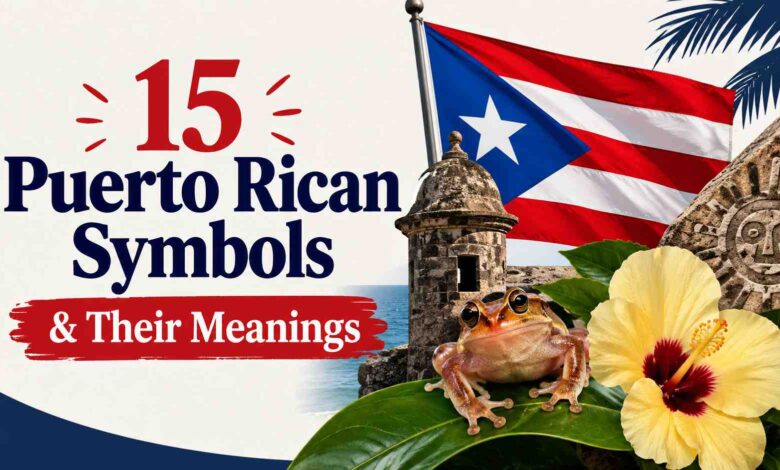
The Puerto Rican flag is one of the clearest visual expressions of Puerto Rican identity. It features five alternating red and white stripes, a blue triangle, and a white five-pointed star.
The flag has a long political and cultural history. Its design dates to the 19th-century Puerto Rican independence movement and was influenced by the Cuban flag.
Today, the flag appears everywhere from homes and public celebrations to clothing, murals, artwork, and cultural events. For many people, it represents pride in Puerto Rico and a connection to Puerto Rican heritage.
The Coquí Frog
The coquí is perhaps the most recognisable natural symbol associated with Puerto Rico. These small frogs are native to the island, and the males are famous for their distinctive nighttime call.
The word “coquí” comes from the sound commonly associated with that call. Because the frog is so closely connected with the island’s landscape, it has become a powerful symbol of home and belonging.
For Puerto Ricans living away from the island, the coquí can have an especially emotional meaning. Its call is often associated with memories of Puerto Rico and a connection to where they come from.
Taíno Symbols and Indigenous Heritage
Taíno heritage is an important part of Puerto Rico’s cultural history. Before European colonisation, Taíno communities lived throughout the Caribbean, including Puerto Rico.
Taíno symbols can be found in archaeological sites, petroglyphs, artwork, jewellery, and modern cultural designs. Common motifs include human and animal figures, geometric forms, and representations associated with Taíno beliefs.
However, it is important to avoid treating every modern “Taíno symbol” as having one fixed meaning. Interpretations can vary, and some designs sold today are modern adaptations rather than direct reproductions of an ancient symbol.
The Taíno Sun
The Taíno sun is one of the most recognisable indigenous motifs associated with Puerto Rico. Modern versions commonly show a circular face surrounded by rays or geometric forms.
It is frequently used in jewellery, artwork, tattoos, and cultural designs as an expression of indigenous heritage.
The term “Taíno sun” is also used broadly today, so readers should distinguish between historically documented archaeological imagery and modern designs inspired by Taíno art.
The Flor de Maga
The Flor de Maga is Puerto Rico’s national flower. It is the flower of Thespesia grandiflora, a tree native to Puerto Rico and closely related to the hibiscus family.
Its large, striking flowers make it a natural symbol of the island’s botanical heritage and beauty.
The Flor de Maga is often featured in artwork, decorations, souvenirs, and cultural designs. Unlike a generic tropical flower, it has a specific connection to Puerto Rican identity.
The Royal Palm
The royal palm, commonly associated with Puerto Rico’s tropical landscape, is another familiar natural symbol.
Tall palms are a defining part of many Caribbean landscapes, and Puerto Rico’s royal palms can be seen in rural areas, roadsides, valleys, and other parts of the island.
The tree is often associated with strength, elegance, and the tropical character of Puerto Rico.
Puerto Rican Birds
Puerto Rico has several bird species that have become important symbols of the island’s natural heritage.
Puerto Rican Parrot
The Puerto Rican parrot, known as the iguaca, is an endemic species and one of Puerto Rico’s most important conservation symbols. Its history reflects both the richness of the island’s wildlife and the challenges faced by native species.
Because of its rarity and conservation story, the parrot can represent resilience, ecological importance, and Puerto Rico’s unique biodiversity.
Puerto Rican Tody
The Puerto Rican tody is a tiny, colourful bird found in Puerto Rico. Its small size and distinctive appearance make it one of the island’s memorable native birds.
It is especially useful as a symbol of Puerto Rico’s natural uniqueness because it is strongly associated with the island’s ecosystem.
Puerto Rico’s Coat of Arms
Puerto Rico’s coat of arms is an official emblem with roots in the island’s Spanish colonial history.
The shield includes imagery such as a lamb carrying a cross and a book, along with castles and lions associated with Spanish royal and historical symbolism.
Unlike the coquí or Flor de Maga, the coat of arms is strongly connected to Puerto Rico’s historical and governmental identity. It can therefore be useful when discussing official Puerto Rican symbols rather than cultural symbols in general.
La Borinqueña
La Borinqueña is the national anthem of Puerto Rico. Its name comes from Borinquen, a name historically associated with the island.
The anthem is an important part of Puerto Rican national identity and is performed at official occasions, ceremonies, and cultural events.
Its significance also shows that symbols do not have to be visual. Music and language can carry national identity just as strongly as a flag or emblem.
The Ceiba Tree
The ceiba tree has a deep cultural presence in Puerto Rico and throughout the wider Caribbean.
Large ceiba trees can become striking landmarks because of their broad trunks, extensive branches, and powerful appearance. The tree is also connected with indigenous and Caribbean traditions.
Today, the ceiba can represent nature, longevity, roots, and a connection with earlier generations.
Cemi or Zemi
A cemi, also written as zemi, refers to a sacred representation or spiritual being associated with Taíno culture.
Cemis could take different forms, including carved objects and three-pointed sculptures. They were connected with Taíno religious beliefs and ceremonies.
Because cemi imagery has genuine historical and archaeological significance, it should be treated as more than a generic decorative symbol. Modern reproductions and tattoo designs may be inspired by this heritage without being exact historical objects.
Bomba and Plena
Puerto Rican identity is also expressed through music and dance.
Bomba developed within Afro-Puerto Rican communities and is closely associated with drumming, dance, movement, and communal expression. Plena is another important Puerto Rican musical tradition, often known for its storytelling and social commentary.
Together, bomba and plena demonstrate the strong African influence within Puerto Rican culture. They are cultural symbols because they preserve history while continuing to evolve in modern communities.
El Morro and Old San Juan
Symbols of Puerto Rico are not limited to animals, plants, or graphic designs. Places can become powerful cultural symbols too.
Castillo San Felipe del Morro, commonly called El Morro, is one of Puerto Rico’s most recognisable landmarks. Its massive fortifications overlook the entrance to San Juan and reflect centuries of colonial history.
The colourful streets, architecture, and historic setting of Old San Juan similarly represent Puerto Rico’s layered past and remain instantly recognisable parts of its visual identity.
Looking for more cultural symbols and their meanings? [Latest Article]
Puerto Rican Symbols in Tattoos and Art
Puerto Rican symbols are frequently used in tattoos, murals, jewellery, clothing, posters, and other forms of visual expression.
Popular choices include:
- The Puerto Rican flag
- The coquí
- Taíno-inspired designs
- The Flor de Maga
- The ceiba tree
- The Taíno sun
- Puerto Rican birds
- El Morro
- Bomba and plena imagery
The best design depends on what the person wants to express. A coquí may communicate a feeling of home, while a Taíno-inspired design may focus more specifically on indigenous heritage.
When using historical or indigenous imagery, learning about its background is worthwhile. It helps prevent a meaningful cultural symbol from being reduced to a generic decoration.
Official vs Cultural Puerto Rican Symbols
One of the easiest ways to understand Puerto Rican symbols is to separate official emblems from symbols that became culturally important.
| Type | Examples |
|---|---|
| National symbols | Flag, coat of arms, anthem |
| National nature symbols | Flor de Maga, royal palm |
| Wildlife symbols | Coquí, Puerto Rican parrot, Puerto Rican tody |
| Indigenous symbols | Cemi, Taíno-inspired imagery |
| Cultural traditions | Bomba, plena |
| Historic landmarks | El Morro, Old San Juan |
This distinction prevents a common mistake: assuming every famous Puerto Rican image has exactly the same official status.
Why Puerto Rican Symbols Matter
Symbols can preserve identity when people move, generations change, and communities spread around the world.
For Puerto Ricans and members of the diaspora, an image such as the flag or coquí can create an immediate connection to family, language, childhood memories, and cultural heritage. For others, these symbols provide an introduction to Puerto Rico’s complicated and diverse history.
Their meanings can also change depending on context. A flag displayed at a national celebration, a Taíno-inspired tattoo, and a coquí on a souvenir may all communicate Puerto Rican identity in different ways.
Frequently Asked Questions
What is the most famous Puerto Rican symbol?
The Puerto Rican flag is one of the most recognisable official symbols, while the coquí is one of the island’s most famous cultural and natural symbols.
What does the coquí symbolise in Puerto Rico?
The coquí commonly represents home, belonging, and Puerto Rican identity because the frog is native to Puerto Rico and is strongly associated with its nighttime soundscape.
What is the national flower of Puerto Rico?
Puerto Rico’s national flower is the Flor de Maga, the flower of Thespesia grandiflora.
What are Taíno symbols?
Taíno symbols are forms and images associated with the indigenous Taíno culture of the Caribbean. In Puerto Rico, archaeological petroglyphs and artefacts provide important evidence of Taíno artistic and spiritual traditions.
Is the coquí an official national symbol?
The coquí is an extremely important cultural and natural symbol of Puerto Rico, but it should not automatically be described as an official national emblem simply because it is widely recognised.
What symbols represent Puerto Rican pride?
The Puerto Rican flag, coquí, Flor de Maga, Taíno-inspired imagery, bomba and plena, and Puerto Rican landmarks such as El Morro can all represent Puerto Rican pride.
What is the meaning of the Taíno sun?
The Taíno sun is widely used today as a symbol of indigenous heritage and connection to Taíno culture. Specific interpretations can vary depending on the historical source or modern design.
Final Thoughts
Puerto Rican symbols bring together several layers of identity: indigenous heritage, Spanish colonial history, African cultural influence, the island’s natural environment, and modern Puerto Rican life.
The flag may express national pride, the coquí can evoke home, the Flor de Maga highlights the island’s natural heritage, while Taíno imagery connects modern audiences with an important part of Puerto Rico’s indigenous past.
Understanding those differences makes these symbols more meaningful. They are not simply attractive images; many carry stories about identity, history, culture, nature, and belonging.