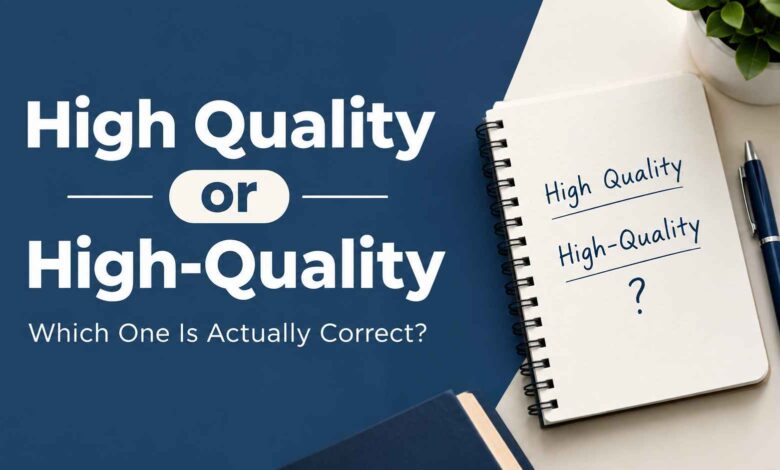
High quality and high-quality look almost identical, but they follow different grammar rules depending on where they land in a sentence. Get the placement wrong and a sentence can read as slightly off — even though most readers won’t be able to say exactly why. This guide breaks down the rule in plain terms, shows you where the hyphen belongs, and covers the exceptions that trip people up.
The Short Answer
Use high-quality (with a hyphen) when the phrase sits directly before a noun: a high-quality laptop, high-quality materials. Use high quality (no hyphen) when it follows a linking verb like “is,” “seems,” or “feels”: the laptop is high quality.
The hyphen isn’t decorative — it tells the reader that “high” and “quality” are acting as a single descriptive unit, rather than two separate words that each modify the noun independently.
Why the Hyphen Matters: Compound Adjectives Explained
English uses hyphens to bind two or more words into what’s called a compound adjective (or compound modifier) when they work together to describe a noun that comes right after them. Without the hyphen, a reader briefly has to guess whether “high” is modifying “quality” or modifying the noun directly.
Compare:
- a high quality control process (ambiguous — is the process “high,” or is the “quality control” high?)
- a high-quality control process (clear — the process itself is high-quality)
This is the same logic behind other compound adjectives you’ve probably used correctly without thinking about it: well-known author, fast-paced thriller, state-of-the-art facility. In each case, the hyphen only appears when the phrase comes before the noun it’s describing.
“High Quality” as a Noun Phrase
When “high quality” follows a verb instead of preceding a noun, it isn’t functioning as a compound adjective anymore — it’s acting more like a descriptive noun phrase referring to a general standard.
Correct examples:
- The fabric is of high quality.
- Customers expect high quality from this brand.
- Her work has always been high quality.
Notice that in each case, nothing immediately follows “high quality” for it to modify. It’s describing the overall state of something, not attaching itself to a noun.
“High-Quality” as a Compound Adjective
When the phrase comes before a noun, hyphenate it. This is the form you’ll see constantly in marketing copy, product descriptions, and reviews, because that’s exactly where the construction is most useful.
Correct examples:
- They sell high-quality furniture.
- This is a high-quality microphone for the price.
- We only hire high-quality contractors.
If you’re building out a broader style guide for your own writing, it’s worth checking [Writing or Writting: Which Spelling Is Correct?] for a rundown of other compound-adjective rules that follow the same pattern.
Quick-Reference Table
| High Quality | High-Quality | |
|---|---|---|
| Grammar role | Noun phrase | Compound adjective |
| Typical position | After a verb (is, seems, feels) | Before a noun |
| Example | “The service is high quality.” | “A high-quality service.” |
| Common in | General statements, evaluations | Product listings, marketing copy |
Common Mistakes People Make
- Hyphenating after a verb — “The product is high-quality” is technically inconsistent with the standard rule, since nothing follows for the hyphenated form to modify.
- Dropping the hyphen before a noun — “a high quality product” is a frequent slip, especially in casual writing and headlines.
- Treating it as a fixed phrase — some writers hyphenate or don’t hyphenate no matter where it falls in the sentence, which misses the actual rule.
Worth knowing: real-world usage is messier than the rule suggests. Plenty of established websites and even edited publications use “high quality” before a noun without a hyphen, and it rarely causes real confusion for readers. If you’re writing for a style guide, an editor, or academic work, follow the hyphenation rule strictly. If you’re writing casual marketing copy and consistency across your own content matters more than textbook precision, the “error” is a minor one at most.
Does This Rule Apply to Similar Phrases?
Yes. The same before-noun/after-verb logic applies to comparable adjectives:
- high-end device vs. the device is high end
- top-quality ingredients vs. the ingredients are top quality
- well-made product vs. the product is well made
Once you recognize the pattern in “high-quality,” it becomes much easier to apply consistently elsewhere.
A Simple Test You Can Run in Your Head
Before you type either version, ask: is this phrase sitting directly in front of a noun it’s describing?
- Yes → hyphenate: high-quality [noun]
- No → leave it open: high quality
If you can mentally swap in a single word like “excellent” and the sentence still makes sense in the same position, that’s a strong sign you’re dealing with the adjective form and should hyphenate.
FAQ
Is “high quality” and “high-quality” the same thing?
They mean the same thing — both describe something excellent or superior — but they’re used differently depending on sentence position. “High quality” is a noun phrase used after verbs; “high-quality” is a compound adjective used before nouns.
Is it wrong to write “high quality product” without a hyphen?
By the standard rule, yes — before a noun it should be hyphenated as “high-quality product.” In practice, you’ll see the unhyphenated version everywhere, so it won’t always be flagged as an error outside formal or edited writing.
Should I hyphenate “high quality” in a title or headline?
If the phrase is directly followed by a noun in the title, hyphenate it. If it’s used more loosely or stands alone, you can leave it open.
Does AP style treat this differently from Chicago style?
Both AP and Chicago style generally follow the same core rule: hyphenate compound modifiers before a noun. Always check the specific guide you’re following if you need strict consistency for a publication.
Can “high-quality” ever appear after a verb?
It’s not the traditional rule, but it does show up informally — for example, “this product is high-quality” — largely because writers are treating the phrase as a single fixed unit rather than applying the grammar rule strictly.
Conclusion
The rule is straightforward once you isolate it: hyphenate “high-quality” when it comes before a noun, and leave “high quality” open when it follows a verb. The distinction is grammatical rather than a difference in meaning, so getting it right is mostly about noticing where the phrase sits in your sentence — not memorizing two separate definitions.