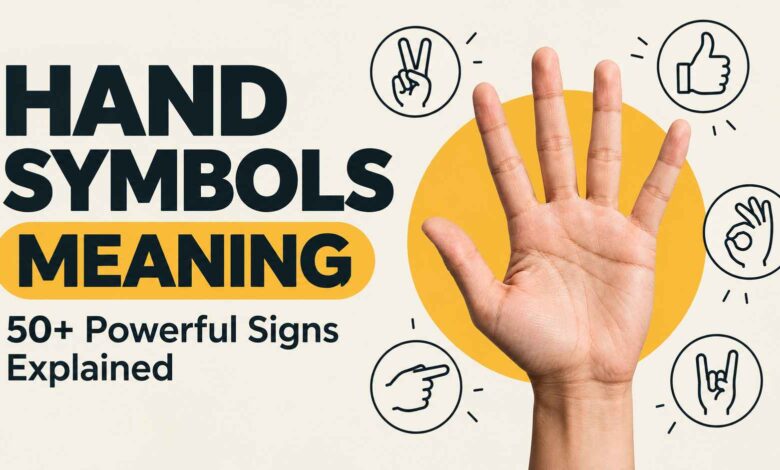
Hand symbols meaning can change dramatically depending on the gesture, culture, religion, and situation. A raised palm may mean “stop,” while an open hand can represent welcome or generosity. A closed fist may express determination, and crossed fingers often represent hope or good luck.
This guide explains the hand symbols meaning behind common gestures, religious signs, traditional symbols, and modern hand emojis. You’ll also learn which gestures can be misunderstood across cultures and what they can mean in different contexts.
What Are Hand Symbols?
Hand symbols are gestures, images, or hand positions that communicate an idea without spoken or written language. Some are simple everyday signals, while others have religious, historical, political, or cultural significance.
You encounter them in many places:
- Everyday conversations and greetings
- Religious ceremonies and artwork
- Sign languages
- Tattoos and jewellery
- Social media and messaging
- Sports and entertainment
- Protest movements
- Traditional art and cultural practices
The important thing is that there is no single universal meaning for every hand gesture. Context matters. The same movement can be friendly in one country and offensive in another.
Common Hand Symbols and Their Meanings
Here is a quick reference to some of the most recognisable hand gestures.
| Hand symbol | Common meaning | Important context |
|---|---|---|
| Open palm | Stop, peace, openness | Meaning changes with palm direction |
| Thumbs up | Approval, agreement | Offensive in some cultures |
| Thumbs down | Disapproval, rejection | Usually negative |
| V sign | Peace or victory | Palm direction can change its meaning |
| Raised fist | Solidarity, resistance, strength | Also used as a celebration gesture |
| OK sign | Okay, agreement | Has different meanings in some countries |
| Shaka | Friendliness, relaxation | Strongly associated with Hawaii |
| Pointing finger | Direction, attention | Can seem aggressive when aimed at people |
| Waving hand | Hello or goodbye | Cultural variations exist |
| Praying hands | Prayer, gratitude, devotion | Also used as a greeting or thanks |
| Heart hands | Love, support, affection | Popular in modern pop culture |
| Crossed fingers | Hope or good luck | Sometimes used jokingly about promises |
| Fist bump | Greeting, teamwork | Informal alternative to a handshake |
| High five | Celebration, congratulations | Usually social and positive |
| Handshake | Agreement, greeting, trust | Customs differ between cultures |
Hamsa Hand Meaning
The Hamsa is one of the best-known protective hand symbols. It is generally depicted as an open hand, often with an eye in the centre.
Its meaning is commonly connected with:
- Protection
- Blessings
- Warding off the evil eye
- Good fortune
- Spiritual protection
The symbol has a long history across the Middle East and North Africa and has been used in Jewish and Muslim communities, among others. Its precise interpretation can vary according to tradition.
You may see the Hamsa on jewellery, wall decorations, artwork, amulets, and tattoos. Some people use it as a religious symbol, while others appreciate it primarily as a cultural or decorative motif.
Mudras and Sacred Hand Gestures
Mudras are symbolic hand positions particularly associated with Hindu and Buddhist traditions. They appear in meditation practices, religious art, dance, sculpture, and ritual.
Some widely recognised examples include:
| Mudra | General association |
|---|---|
| Dhyana Mudra | Meditation and concentration |
| Abhaya Mudra | Fearlessness and protection |
| Varada Mudra | Giving, generosity and compassion |
| Vitarka Mudra | Teaching and discussion |
| Anjali Mudra | Respect, greeting and devotion |
| Gyan/Jnana Mudra | Knowledge and concentration |
The exact interpretation of a mudra depends on the tradition and artistic context. It is better to think of mudras as part of a larger symbolic system rather than assuming that every finger position has one universal meaning.
Raised Fist Meaning
The raised fist is strongly associated with strength, solidarity, resistance, and collective action.
Its modern history includes labour movements, civil rights activism, political movements, and protests. It has also appeared in artwork and popular culture.
Context is especially important here. A person raising a fist at a celebration may simply be expressing excitement or victory, while the same gesture at a demonstration can communicate solidarity or resistance.
The symbol does not automatically mean violence.
Peace Sign Meaning
The V-shaped peace sign is made by raising the index and middle fingers.
It is commonly associated with:
- Peace
- Non-violence
- Victory
- Friendship
- Casual positivity
The modern peace movement connection dates to the nuclear disarmament movement of the late 1950s. Over time, the gesture became much broader and is now frequently used in photographs and everyday communication.
Palm direction matters in some English-speaking cultures. In the UK and some other countries, turning the V sign inward can be interpreted as an insult.
Thumbs Up and Thumbs Down
Thumbs Up
A thumbs-up gesture usually communicates approval, agreement, encouragement, or that something is going well.
You might use it to say:
“That works.”
or
“Good job.”
However, it should not be treated as universally positive. Gesture meanings can vary considerably between countries and communities.
Thumbs Down
The thumbs-down gesture generally communicates:
- Disapproval
- Rejection
- Failure
- “No”
- Negative feedback
It is particularly common online because platforms use thumbs-up and thumbs-down icons for reactions and ratings.
OK Hand Symbol Meaning
The OK gesture is formed by touching the thumb and index finger to create a circle.
In many contexts, it means “okay,” “fine,” or “all good.” It is also used as a safety signal in scuba diving.
But its interpretation is not universal. In some cultures it can mean “zero” or have an insulting meaning. It has also acquired additional political associations in certain contexts, so the surrounding situation matters.
For ordinary communication, don’t assume everyone will interpret it exactly as you do.
Shaka Sign Meaning
The Shaka sign is made by extending the thumb and little finger while curling the other fingers.
It is strongly connected with Hawaii and surfing culture and commonly conveys:
- Friendliness
- Relaxation
- Good vibes
- “Hang loose”
- Aloha spirit
Unlike many gestures with complicated historical interpretations, the Shaka is often used today as a relaxed, informal expression of friendliness.
Praying Hands Meaning
Pressed palms are associated with prayer, devotion, gratitude, respect, and spiritual reflection.
The gesture appears in different religious and cultural traditions, although the exact meaning is not identical everywhere.
In digital communication, the praying-hands emoji is also used for meanings such as:
- “Please”
- “Thank you”
- “I hope so”
- Prayer
- Gratitude
- Respect
So an emoji that looks religious can have a much broader everyday meaning.
Heart Hand Symbols Meaning
The heart-hand gesture is created by bringing the fingers and thumbs together to suggest the shape of a heart.
It generally communicates:
- Love
- Affection
- Appreciation
- Support
- Friendship
The gesture became especially visible through photography, entertainment, social media, and Korean pop culture before becoming widely recognised internationally.
It is now one of the clearest modern examples of a hand gesture spreading through global media.
Pointing Finger Meaning
A raised index finger can mean attention, direction, instruction, authority, or emphasis.
For example, someone might raise one finger while making an important point.
Pointing directly at another person is different. In many situations, it can appear confrontational, accusatory, or impolite.
The gesture can also have religious significance. In Islamic contexts, raising the index finger can be associated with affirming the oneness of God, although practices and interpretations vary.
Waving Hand Meaning
A wave usually means hello or goodbye.
It is one of the first gestures many children learn and is widely understood in everyday situations. However, even a simple wave can have different cultural interpretations depending on how it is performed.
The safest approach when travelling is to observe how local people use gestures rather than assuming every gesture has the same meaning as it does at home.
Crossed Fingers Meaning
Crossing the index and middle fingers is commonly associated with hope, luck, or wishing for a positive outcome.
For example:
“I have my fingers crossed for you.”
Historically, explanations for the gesture vary, and some popular stories about its origins are difficult to establish with certainty. Today, its everyday meaning is much clearer: people generally use it to express hope or good luck.
Handshake Meaning
A handshake commonly communicates:
- Greeting
- Agreement
- Cooperation
- Professional respect
- Trust
It is particularly common in business and formal introductions.
However, handshaking customs vary by culture, religion, age, and situation. Some people may prefer a bow, nod, wave, or another greeting instead.
That is why a respectful greeting is not always about using the gesture you personally consider normal.
High Five and Fist Bump Meanings
The high five usually expresses celebration, congratulations, teamwork, or shared excitement.
The fist bump is generally more informal. It can mean friendship, acknowledgement, teamwork, or congratulations.
Both are good examples of how relatively modern gestures can become widely recognised without having a religious or ancient origin.
If you enjoy learning the stories behind visual signs, [Latest Article] can help you explore another fascinating set of symbols.
Hand Symbols in Different Cultures
One of the biggest mistakes people make with gestures is assuming that a familiar sign has one fixed meaning worldwide.
| Gesture | Common Western interpretation | Possible variation |
|---|---|---|
| Thumbs up | Approval | Can be offensive in some regions |
| OK sign | Everything is fine | May mean zero or be offensive elsewhere |
| V sign | Peace/victory | Inward-facing version can be insulting in some countries |
| Beckoning finger | Come here | Considered impolite in some Asian cultures |
| Open palm | Stop or greeting | Meaning changes with movement and orientation |
| Pointing | Showing direction | May be considered rude in some settings |
| Shaka | Friendly, relaxed | Especially associated with Hawaii |
| Praying hands | Prayer/thanks | Can also function as a greeting |
When travelling, context is more important than memorising a huge list of gestures. If you’re unsure, use a neutral greeting and follow local customs.
Religious and Spiritual Hand Symbols
Hands have an important place in religious art and ritual around the world.
In Christianity, hands may appear in gestures of blessing, prayer, healing, or teaching. Buddhist artwork frequently uses mudras to communicate specific aspects of the Buddha’s teaching or state.
In Hindu traditions, mudras are used in ritual, dance, meditation, and religious imagery. The Hamsa is associated with protection in several Middle Eastern and North African traditions.
These symbols should be understood within their traditions rather than reduced to a single universal definition.
Hand Symbols in Sign Language
Not every hand sign is simply a symbolic gesture. Sign languages are complete languages.
American Sign Language (ASL), for example, uses handshapes, movement, facial expressions, body position, and space to communicate meaning. It has its own grammar and structure.
A few familiar examples include:
- The ASL alphabet uses distinct handshapes for letters.
- The “I love you” handshape combines elements representing I, L, and Y.
- Numbers have their own hand configurations.
- Many everyday concepts have dedicated signs rather than being spelled letter by letter.
This distinction matters because calling all sign-language communication “hand symbols” can make a complete language seem like a collection of simple gestures.
Hand Symbols in Art, Tattoos, and Design
Hand imagery is popular because hands can communicate emotion quickly.
A designer might use an open palm to suggest welcome, while an intertwined pair of hands can represent connection or cooperation. A raised fist can communicate strength, while a Hamsa can suggest protection.
For tattoos, the meaning becomes more personal. Someone might choose:
- Hamsa for protection
- Praying hands for faith
- Heart hands for affection
- Open palm for openness
- Raised fist for resilience or solidarity
- Mudra for meditation or spiritual practice
Before choosing a culturally specific symbol as a permanent design, it is worth checking its history and meaning carefully.
How to Interpret a Hand Gesture Correctly
If you’re trying to understand what someone’s hand gesture means, don’t look at the fingers alone.
Consider these five things:
- Location: Where did the gesture happen?
- Culture: What traditions influence the person using it?
- Direction: Which way are the palm and fingers facing?
- Situation: Is it a greeting, joke, protest, prayer, celebration, or warning?
- Other signals: Facial expression and body language can change the interpretation.
For example, a raised open palm could mean “stop” during a conversation but simply be a friendly wave from across a street.
FAQ About Hand Symbols Meaning
What is the most common hand symbols?
There is no single universally most common hand symbol. Gestures such as waving, thumbs up, pointing, and open palms are widely recognised, but their exact meanings depend on context and culture.
What does the Hamsa hand symbols mean?
The Hamsa is commonly associated with protection, blessings, and protection from the evil eye. It has a long history across several Middle Eastern and North African traditions.
What does a raised fist symbolize?
A raised fist can represent strength, solidarity, resistance, determination, or collective action. In other situations, it may simply express celebration or victory.
What does the V hand symbols mean?
The V sign commonly means peace or victory. However, palm direction can change its meaning in countries such as the UK and Australia.
Why do hand gestures have different meanings in different countries?
Gestures develop through local customs and social traditions. As a result, the same movement can acquire completely different meanings in different cultures.
What does the OK hand sign mean?
The OK sign usually means “okay,” “fine,” or “all good.” However, it can mean something different or offensive in certain countries and contexts.
Are mudras religious hand symbols?
Many mudras have religious or spiritual significance, particularly in Hindu and Buddhist traditions. They can also appear in meditation, dance, ritual, and traditional artwork.
What does the praying hands symbols mean?
Praying hands commonly represent prayer, faith, gratitude, hope, or respect. In online messages, the same symbol can simply mean “please” or “thank you.”
Can the same hand gesture have opposite meanings?
Yes. A gesture’s meaning can change based on culture, palm direction, movement, and situation. This is one reason it is risky to assume that familiar gestures are universally understood.
Conclusion
Hand gestures are much more than simple movements. They can communicate approval, protection, peace, resistance, gratitude, friendship, faith, and countless other ideas.
The most important lesson when exploring hand symbols meaning is that context matters. A thumbs-up, V sign, open palm, or OK gesture may seem obvious to you, but another culture may read it differently.
So when you encounter an unfamiliar hand symbol, look beyond the shape of the fingers. Consider its cultural background, setting, history, and the person’s intention. That approach will give you a much more accurate understanding of what the gesture is actually saying