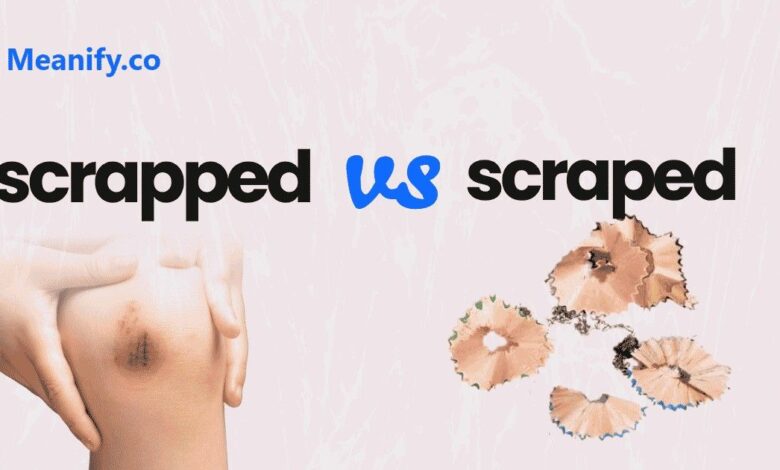
You typed it, then paused. Was the plan scrapped, or was your knee scraped? One extra letter separates cancelled forever from rubbed raw. This guide breaks down scrapped vs scraped so you never second-guess the spelling again — with real examples, grammar rules, and memory tricks that stick.
Scrapped vs Scraped — The Core Difference at a Glance
Here’s the short version. Scrapped means something was discarded, abandoned, or cancelled on purpose. Scraped means something was rubbed, scratched, or removed by friction against a surface. One is a decision. The other is physical contact.
| Word | Core Meaning | Example |
|---|---|---|
| Scrapped | Discarded or cancelled | The company scrapped the merger. |
| Scraped | Rubbed or removed by friction | He scraped his elbow on the wall. |
Once you separate decision from contact, the confusion mostly disappears. Keep that mental split in your back pocket as we go deeper into each word.
Scrap or Scrape? Understanding the Base Words First
Before “scrapped” and “scraped” existed, there was scrap and scrape. Scrap is a base verb form meaning to throw away or cancel — it’s also a noun for a small leftover fragment, like scrap metal or scrap paper. Scrape, on the other hand, always involves motion: dragging, rubbing, or shaving something off a surface.
This distinction matters because the past tense keeps the meaning intact. Scrap becomes scrapped. Scrape becomes scraped. Neither word changes its core idea just because it shifts in tense, so getting the base word right solves half the battle immediately.
What Does “Scrapped” Mean? (Definition, Origin & Examples)
Scrapped is the past tense verb of “scrap,” meaning something was abandoned, terminated, or thrown out entirely. It traces back to Middle English and Old Norse roots, where skrap referred to small waste fragments — think junkyard leftovers, not decisions. Over centuries, English turned that noun into a verb meaning “reduce to scrap.”
You’ll see it constantly in business writing: a scrapped project, a scrapped plan, a scrapped proposal. For example: “After months of testing, engineers scrapped the prototype due to safety concerns.” Notice the tone — final, deliberate, done. Nothing physical touched anything here; a decision simply ended something.
What Does “Scraped” Mean? (Definition, Origin & Examples)
Scraped is the past tense of “scrape,” rooted in Old English scrapian and Old Norse skrapa, both meaning “to scratch.” Unlike scrapped, this word always involves friction — something dragged or rubbed against a surface, whether that’s skin, metal, or a windshield.
Real examples make this click fast: “She scraped ice off the windshield before work.” Or in tech: analysts run web scraping tools to collect scraped data from public websites. Whether it’s a scraped knee or a scraped webpage, the pattern holds — material gets pulled off a surface through contact, not cancelled through choice.
Scraped Knee or Scrapped Knee? (The Most Common Mix-Up)
If you fall off a bike, you get a scraped knee — never a “scrapped knee.” Skin rubbed against pavement. Friction happened. Tissue got damaged. That’s physical contact, which always points to “scraped,” not “scrapped.”
If you’ve ever wondered whether other confusing word pairs follow the same logic, it’s worth checking out [Requestor vs Requester: Which Spelling Is Correct in 2026?] — the reasoning behind that mix-up runs surprisingly close to this one.
Scrapped vs Scraped — Side-by-Side Comparison Table
Sometimes a table settles an argument faster than a paragraph ever could. Here’s a direct comparison table covering grammar, spelling logic, and typical use so you can scan it in seconds before hitting publish.
| Feature | Scrapped | Scraped |
|---|---|---|
| Base verb | Scrap | Scrape |
| Spelling rule | Double consonant + “-ed” | Drop silent “e” + “-ed” |
| Core action | Cancel or discard | Rub or remove by friction |
| Typical context | Business decision, project | Injury, cleaning, data |
| Example | The board scrapped the deal. | He scraped mud off his boots. |
Notice the spelling logic isn’t random. “Scrap” ends in a single consonant after a short vowel, so English doubles it. “Scrape” ends in a silent “e,” so English drops it before adding “-ed.” That’s plain morphology, not an accident of typing.
Synonyms for Scrapped and Scraped
Building a mental list of alternatives reinforces which word belongs where. For scrapped, think abandoned, eliminated, discontinued, axed, jettisoned, or dropped — all describing decisions, never physical contact.
For scraped, think scratched, grazed, shaved, scoured, or stripped — words describing action against a surface. If a synonym involves a tool, a hand, or friction, “scraped” is almost always the right call.
Common Mistakes and Why Writers Make Them
Most people don’t confuse these words out of ignorance. They confuse them because typing errors and autocorrect errors creep in when writing fast. The words sound close enough in casual speech that your fingers sometimes follow the sound instead of the meaning.
Context awareness fixes this instantly. Ask yourself: did I mean a decision, or a physical action? “They scraped the merger” should read “They scrapped the merger,” since a merger gets cancelled, not rubbed. Small swap, big difference in writing accuracy and professional writing overall.
Easy Tricks to Remember the Difference Forever
Forget complicated grammar rules — two quick anchors solve this permanently. First: Scrap equals trash. If you can throw it in a bin or cancel it outright, you want “scrapped.” Second: Scrape equals scratch. If friction or rubbing is involved, “scraped” is your word.
Before you hit send, ask one question: am I removing something physically, or getting rid of it entirely? Physical answer means scraped. Decision answer means scrapped. That single check catches almost every mistake before it happens.
FAQs on Scrapped vs Scraped
What’s the difference between scraped and scrapped?
Scrapped means something was cancelled or discarded, while scraped means something was physically rubbed or removed from a surface.
Is it a scraped knee or scrapped knee?
Always “scraped knee.” A knee gets injured through friction, not cancelled through decision.
Can scrapped and scraped be used interchangeably?
No. They describe entirely different actions — one is a decision, the other is physical contact — and swapping them changes the meaning of your sentence.
What is scraped data?
It refers to information pulled from websites using automated tools, a process known as web scraping, common in market research and pricing analysis.
Why do people confuse scrapped and scraped so often?
They’re close in sound and spelling but not true homophones — closer to heterographs, words that look and sound similar yet carry different meanings entirely.
Conclusion
The difference between scrapped vs scraped comes down to one simple question: decision or contact? Scrapped means something got cancelled or thrown away. Scraped means something got rubbed, scratched, or removed by friction. Keep that distinction in mind, and one extra letter will never trip up your writing again.