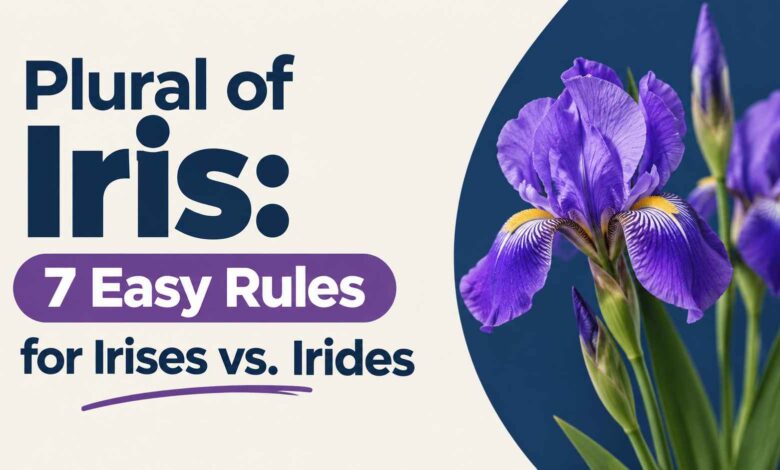
If you are wondering about the plural of iris, the most common answer is irises. However, irides is also a recognized plural form, particularly in anatomical or formal contexts. That can make this seemingly simple word surprisingly confusing.
So, is it iris, irises, or irides? The answer depends partly on context and the type of writing you are doing.
In this guide, you will learn the correct iris plural, what iris means, when to use irises or irides, how each form is pronounced, and how to use them naturally in sentences.
What Is the Plural of Iris?
The most common plural of iris is irises. Irides is also a correct plural form, but it is considerably less familiar in everyday English.
| Singular | Common Plural | Alternative Plural |
|---|---|---|
| iris | irises | irides |
For most general writing, irises is the straightforward choice. It can refer to multiple iris flowers or multiple irises of the eye.
For example:
- One flower is an iris.
- Several flowers are irises.
- One eye has an iris.
- Both eyes have irises.
Irides can also be used, especially when discussing the anatomy of the eye in a technical or formal setting.
Quick Answer
If you only need to remember one rule, remember this:
iris → irises
That is the plural form most readers will recognize immediately.
Irises vs. Irides: Which Form Is Correct?
Both irises and irides are legitimate plural forms of iris. The difference is mainly one of usage and familiarity rather than basic correctness.
Irises is the normal plural in general modern English. It works naturally when discussing flowers, eyes, gardens, art, photography, or ordinary conversation.
Irides is an alternative plural that is especially associated with anatomy and more formal or specialized writing.
Consider these examples:
- “The garden was filled with colorful irises.”
- “The doctor examined both irises.”
- “The specialist carefully examined the patient’s irides.”
All three examples can be grammatically valid. The first two use the more familiar form, while the last uses the less common anatomical form.
If your audience consists of general readers, irises will usually be easier to understand.
What Does Iris Mean?
The word iris has several related meanings, but two are especially common.
First, an iris is a flowering plant known for its attractive, often colorful blooms and long leaves.
Second, the iris is the colored part of the human eye surrounding the pupil. It helps regulate the amount of light entering the eye by controlling the size of the pupil.
The same singular word is therefore used in both botanical and anatomical contexts.
Iris as a Flower
An iris is a flowering plant belonging to the genus Iris. Iris flowers are known for their distinctive shapes and can appear in many colors, including purple, blue, yellow, white, and combinations of these shades.
For example:
“A single iris was blooming near the garden wall.”
When there is more than one, the usual plural is irises:
“Several irises were blooming near the garden wall.”
This is the form you are most likely to encounter in gardening articles, flower guides, books, and everyday conversation.
Iris as Part of the Eye
The iris of the eye is the colored structure surrounding the pupil. It plays an important role in regulating light entering the eye.
For example:
“The doctor examined the patient’s iris.”
When referring to more than one:
“The doctor examined both irises.”
In medical writing, you may also encounter irides:
“The specialist examined the patient’s irides.”
Both forms can be found in anatomical contexts, although irises is generally more familiar to a broad audience.
Why Does Iris Have Two Plural Forms?
The two plural forms exist because English has borrowed and adapted words from other languages over time.
The word iris has a long history connected with Greek and Latin. Its original associations included the idea of a rainbow, which helped give the word its various meanings.
English often creates regular plurals by adding -s or -es. That pattern gives us:
iris → irises
At the same time, English has retained some alternative forms influenced by the historical structure of borrowed words. That is where irides comes into the picture.
You therefore do not need to treat irides as a misspelling simply because it looks unusual.
The important distinction is that the two forms are not equally common in everyday English.
When Should You Use “Irises”?
Use irises when you want the most familiar and natural plural form of iris.
It works especially well in:
- Everyday English
- General writing
- School assignments
- Gardening articles
- Descriptions of flowers
- Discussions about eye color
- General anatomy explanations
- Fiction and creative writing
Here are some examples:
- “The garden has dozens of purple irises.”
- “The artist painted several blue irises.”
- “Both irises appeared normal during the examination.”
- “Her painting featured bright yellow irises.”
- “The spring garden was filled with blooming irises.”
For a general audience, there is rarely a reason to make the sentence more complicated by choosing the less familiar irides.
When Is “Irides” Used?
Irides is a recognized alternative plural of iris. You are more likely to see it in specialized, anatomical, medical, or formal writing.
For example:
“The physician examined the patient’s irides for signs of inflammation.”
This construction is possible, but many readers will find irises more familiar:
“The physician examined the patient’s irises for signs of inflammation.”
The choice can therefore depend on the intended audience and style.
If you are writing for medical professionals or discussing anatomy in a specialized context, irides may fit naturally. If you are writing a general article for everyday readers, irises is usually the clearer option.
Plural of Iris for Flowers
The standard everyday plural of iris flower is irises.
For example:
- “The garden contains several beautiful irises.”
- “She planted three purple irises.”
- “The irises began blooming in spring.”
- “The vase was filled with freshly cut irises.”
There is no need to use irides when you are simply talking about flowers.
So, if someone asks:
What is the plural of iris flower?
The simple answer is:
Irises.
Plural of Iris in Anatomy
When iris refers to the colored part of the eye, both irises and irides can be used.
For general readers:
“The doctor examined both irises.”
In specialized anatomical writing:
“The physician examined the patient’s irides.”
The word irides is therefore particularly worth knowing if you read medical or scientific material.
However, it does not mean that irises suddenly becomes incorrect in anatomy. Irises remains a valid and widely understandable plural.
A Simple Comparison
| Context | Recommended Familiar Form | Alternative |
|---|---|---|
| Iris flowers | irises | — |
| General eye discussion | irises | irides |
| Medical writing | irises | irides |
| Everyday conversation | irises | — |
| Formal anatomical writing | irises | irides |
Is Iris a Regular or Irregular Plural?
The plural irises follows a regular English plural pattern.
Because iris ends in -s, adding -es produces:
iris + es = irises
This is similar to other English words that require an -es ending for their plural forms.
However, irides does not follow that regular modern English pattern. It represents an alternative plural influenced by the word’s historical development.
That is why you may encounter both forms in dictionaries.
For practical purposes, the easiest rule is:
One iris → two or more irises.
How Do You Pronounce Iris, Irises, and Irides?
Pronunciation is another reason people sometimes hesitate over these words.
Iris
Iris is commonly pronounced approximately:
EYE-ris
Example:
“I planted an iris in the garden.”
Irises
Irises is commonly pronounced approximately:
EYE-riss-iz
It has an extra syllable compared with the singular.
Example:
“The irises are blooming.”
Irides
Irides is commonly pronounced approximately:
EYE-ri-deez
This pronunciation can sound unfamiliar if you have mainly encountered irises.
If you are learning English, focusing on iris and irises first is perfectly practical because these are the forms you are most likely to encounter in ordinary communication.
Iris Singular and Plural Examples
Seeing the forms in context makes the difference easier to remember.
Singular Iris Examples
- “A purple iris grew beside the walkway.”
- “The doctor examined the patient’s iris.”
- “She photographed a beautiful iris.”
- “The iris surrounds the pupil of the eye.”
Plural Irises Examples
- “The garden is full of colorful irises.”
- “Several irises bloomed after the rain.”
- “The doctor examined both irises.”
- “The painting shows three blue irises.”
Irides Examples
- “The specialist examined the patient’s irides.”
- “The report described changes in the irides.”
These examples show why context matters. Irises works across both major meanings, while irides is particularly useful in specialized anatomical writing.
Common Mistakes With the Plural of Iris
Although iris is a short word, several mistakes can occur when writing its plural.
Mistake 1: Assuming “Irides” Is Wrong
Because irides is unfamiliar to many English speakers, it can look like a mistake.
It is not simply a misspelling. Irides is a recognized plural form of iris.
Mistake 2: Thinking “Irises” Is Only for Flowers
Some people assume irises should only describe flowers.
That is not correct. You can also use irises for the colored parts of multiple eyes.
For example:
“The doctor examined both irises.”
Mistake 3: Adding an Apostrophe to Make a Plural
Do not write iris’s when you simply mean more than one iris.
The normal plural is:
irises
An apostrophe has a different grammatical function.
For example:
- Plural: “The irises are beautiful.”
- Possessive: “The iris’s color was unusual.”
The exact possessive construction can vary depending on context, but the key point is that an apostrophe does not normally create a simple plural.
Mistake 4: Using “Irides” in Every Sentence
Although irides is correct, using it everywhere can make ordinary writing sound unnecessarily technical.
For most readers, irises is clearer.
Iris vs. Irises vs. Irides at a Glance
Here is the easiest way to remember the three forms:
| Form | Meaning/Use | Example |
|---|---|---|
| iris | One flower or one eye structure | “The iris is purple.” |
| irises | Common plural | “The irises are blooming.” |
| irides | Alternative, often formal/anatomical plural | “The specialist examined the irides.” |
If you are unsure which plural to choose, irises is generally the safest choice for ordinary modern English.
What Is the Origin of the Word Iris?
The word iris has ancient roots and entered English through Latin from Greek.
The Greek word was associated with a rainbow, which connects naturally with the range of colors associated with the flower and the eye.
The word eventually developed several related meanings, including the flower and the colored part of the eye.
The history of iris also helps explain why English has retained the alternative plural irides alongside the more regular irises.
This is common in English: words borrowed from older languages can sometimes retain historical forms while also developing regular English forms.
[ Robthecoins Business Tips: 15 Smart Growth Ideas]
Is “Irises” or “Irides” More Common?
For general modern English, irises is the more familiar form.
You will commonly see irises in:
- Flower descriptions
- Gardening content
- Art and literature
- General anatomy discussions
- Everyday conversation
- News and general-interest writing
Irides is less common and is more likely to appear in specialized or formal contexts.
This difference is about usage and familiarity, not whether one form is grammatically valid and the other is not.
How to Remember the Plural of Iris
You do not need to memorize complicated grammar rules.
Use this simple memory trick:
Iris → Irises
Think of irises as the normal everyday plural.
Then remember:
Irides = alternative formal/anatomical plural
So if you are writing a general article, email, school assignment, or social post, irises will usually be the easiest choice.
Frequently Asked Questions
What is the plural of iris?
The most common plural of iris is irises. Irides is also a recognized alternative plural, especially in formal or anatomical contexts.
Is “irises” grammatically correct?
Yes. Irises is a correct and widely used plural of iris. It can refer to multiple iris flowers or multiple irises of the eye.
Is “irides” a real word?
Yes. Irides is a recognized plural form of iris. It is less common in everyday English and is particularly associated with specialized or anatomical writing.
What is the plural of iris flower?
The usual plural of iris flower is irises.
For example:
“The garden has several beautiful irises.”
What is the plural of iris in anatomy?
In anatomy, both irises and irides can be used. Irises is more familiar to general readers, while irides can appear in specialized anatomical writing.
Which is correct: irises or irides?
Both are recognized plural forms. Irises is the more familiar choice for everyday English, while irides is less common and often used in formal or anatomical contexts.
Can “irises” refer to eyes?
Yes. Irises can refer to the colored parts of multiple eyes.
For example:
“The doctor examined both irises.”
How do you pronounce irises?
Irises is commonly pronounced approximately EYE-riss-iz.
How do you pronounce irides?
Irides is commonly pronounced approximately EYE-ri-deez.
Is “iris” singular or plural?
Iris is normally singular when referring to one flower or one eye structure. Its common plural is irises.
What is the possessive form of iris?
For a singular possessive, iris’s can be used when the meaning requires it.
For example:
“The iris’s color was unusually bright.”
The plural irises should not be confused with the possessive form.
Final Answer: Iris or Irises or Irides?
The simplest answer to “What is the plural of iris?” is irises.
Irides is also correct, but it is a less common alternative that you are more likely to encounter in formal, scientific, or anatomical writing.
Remember these three forms:
- iris = one
- irises = common plural
- irides = alternative plural, especially in specialized contexts
Whether you are talking about colorful flowers or the colored parts of the eyes, irises is the clear, familiar choice for most everyday English.
So when in doubt, use iris → irises.