You’ve typed it, deleted it, and typed it again. Is it cocoon or cacoon? You’re not overthinking it — this is one of the most commonly misspelled words in English, and the confusion has a real explanation.
Quick answer: cocoon is correct in almost every situation. Here’s the fast breakdown:
| Word | Correct? | Meaning |
|---|---|---|
| Cocoon | ✅ Yes | Protective silk casing spun by insects; also used figuratively for comfort or transformation |
| Cacoon | ❌ Usually no | Common misspelling, except as a trademarked hanging-chair brand or a rare botanical term |
What Does Cocoon Actually Mean?
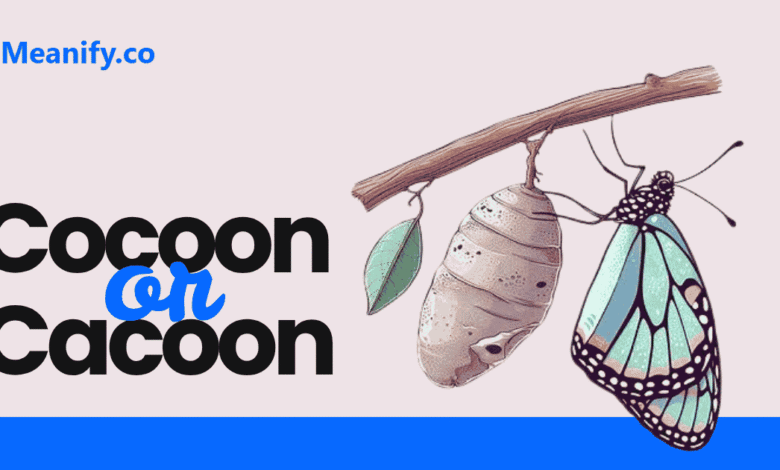
A cocoon is the silky protective case an insect larva spins around itself during metamorphosis, the process of transforming from caterpillar to moth or butterfly. Silkworms are the most famous example, since their cocoons are literally harvested to make silk fabric. A moth or butterfly stays inside the cocoon as a pupa, safe from predators, until it’s ready to emerge.
The word also works figuratively, and this is where cocoon shows up outside biology textbooks:
- Comfort: “She wrapped herself in a cocoon of blankets.”
- Isolation for growth: “He spent the year in a creative cocoon, writing his novel.”
- Marketing: hotels and lifestyle brands love “cocoon-like” rooms or a “cocooning” experience.
This dual meaning, literal insect science and metaphorical safe space, is exactly why cocoon appears so often in both nature writing and lifestyle content.
Why So Many People Misspell Cocoon as Cacoon
Blame your ears, not your intelligence. The first syllable of cocoon is unstressed when spoken, so it comes out as a soft, almost neutral sound. Your brain fills in the gap with whatever vowel feels natural, and for a lot of English speakers, that’s an “a.” This is the same pronunciation-versus-spelling mismatch behind other common typos:
| Correct word | Common misspelling |
|---|---|
| Cocoon | Cacoon |
| Balloon | Baloon |
| Occasion | Ocassion |
| Committee | Comitee |
Autocorrect doesn’t always save you either. Because “cacoon” is a real string of letters tied to a trademark (more on that below), some spell-checkers let it slide instead of flagging it as an error.
If you’ve ever wondered how one small misspelling can quietly drag down a blog’s search traffic for months, [Latest Article] walks through exactly what happened to one site that got this wrong — and how fixing it turned things around.
Is “Cacoon” Ever Correct?
Here’s the one exception worth knowing. Cacoon is a registered brand name used for hanging chairs and hammock-style pods sold for outdoor relaxation. If you’re writing about that specific product line, “Cacoon” with a capital C is correct, because it’s a trademark, not a dictionary word.
Separately, some sources note “cacoon” as an old, rarely used term for a type of large tropical bean or seed pod found in the West Indies, tied to botany rather than biology. Most dictionaries, including Merriam-Webster and Oxford Learner’s Dictionaries, don’t list it as standard English.
| Term | Category | Correct usage |
|---|---|---|
| Cocoon | Biology / general writing | Always — science, metaphor, everyday use |
| Cacoon | Brand name | Only when referring to the hanging-chair product |
| Cacoon | Botany | Rare, dated references to a tropical bean |
Cocoon in Nature: Not Just Silkworms
Cocoons aren’t unique to one insect. Here’s how a few species compare:
| Species | Cocoon type | Purpose |
|---|---|---|
| Silkworm | Fine silk | Protects pupa; harvested for textiles |
| Moth | Fibrous silk | Defense against predators |
| Butterfly | Leaf-bound silk | Shelter during transformation |
| Spider | Web-wrapped | Protects eggs, not the spider itself |
| Caddisfly | Sand and silk | Camouflage from predators |
7 Mistakes People Make With Cocoon vs Cacoon
Most cocoon-related errors fall into a small, predictable set of patterns:
- Writing “cacoon” instead of “cocoon,” usually driven by the pronunciation issue above
- Assuming the two spellings are interchangeable, rather than one being standard and one not
- Confusing cocoon with unrelated words that share a rough sound
- Using cocoon (lowercase) when referring to the branded hanging chair
- Trusting autocorrect blindly instead of checking a dictionary
- Ignoring spell-check suggestions in a rush to publish
- Mixing spellings inconsistently within the same article
On the professional side, the risk isn’t just the typo, it’s what it signals. A misspelling in a school essay, product description, or blog post suggests carelessness, even if the reader understands what you meant. It can also cost you in search rankings, since content that consistently uses the wrong spelling can struggle to match the search intent behind the correct keyword.
How to Remember the Correct Spelling for Good
A visual trick works better than a grammar rule here. Picture the word cocoon as two “o” pairs wrapped around the middle, co plus coon, like two protective rings around the insect inside. That double “o” pattern matches other familiar words:
- Moon
- Cool
- Balloon
- Cocoon
If you want a fail-safe method, type the word, then check it against a real dictionary. Merriam-Webster and Oxford Learner’s Dictionaries both confirm cocoon as the only standard spelling. Doing this once or twice is usually enough to make it stick.
Frequently Asked Questions
Is cacoon a real word?
Only in two narrow senses: as a trademarked brand name for hanging chairs, and as a dated, rarely used botanical term for a tropical bean. Outside those contexts, it’s a misspelling of cocoon.
Which spelling is correct: cacoon or cocoon?
Cocoon is correct for every standard use, including biology, metaphor, and general writing. Cacoon is only correct when referring to the hammock-chair brand.
What does cocoon mean in biology?
A cocoon is the silk casing an insect larva, such as a silkworm or moth, spins around itself to protect the pupa during metamorphosis.
Can cocoon be used as a verb?
Yes. To cocoon means to wrap, envelop, or protect, as in “she cocooned herself in blankets during the storm.”
Does misspelling cocoon actually hurt SEO?
It can. Search engines match content to search intent, and consistently misspelled keywords can reduce how well an article ranks for the term people are actually searching, alongside hurting reader trust in the content’s accuracy.
Conclusion
Cocoon is the word you want in nearly every sentence, whether you’re describing a silkworm’s silk casing, a butterfly’s transformation, or a metaphorical safe space you retreated into last winter. Cacoon only earns its place when you’re specifically naming the hanging-chair brand. Get the double “o” locked into memory, cross-check it once against a dictionary, and you’ll never second-guess this one again. about us