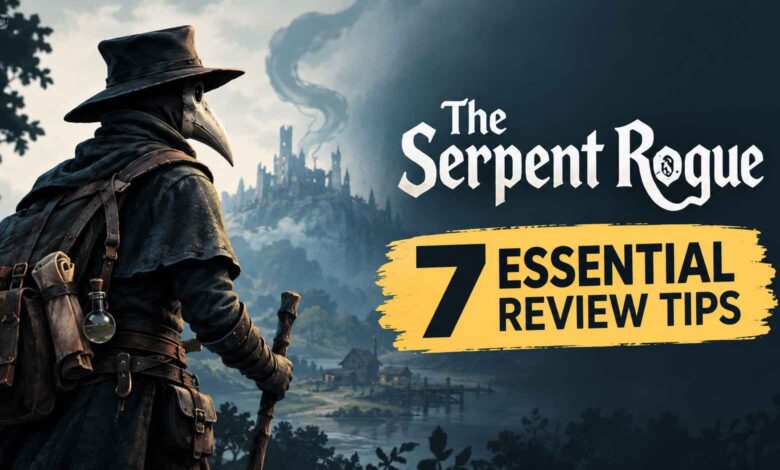
The Serpent Rogue is an atmospheric action-adventure game built around alchemy, exploration, survival, and experimentation. Rather than rewarding players for fighting every enemy they encounter, it encourages careful preparation, resource management, and creative problem-solving. You play as a mysterious Warden tasked with confronting a spreading corruption that threatens the world.
This The Serpent Rogue review explores the game’s strongest features, its frustrating mechanics, potion crafting, combat, exploration, graphics, and sound design. It also explains who is most likely to enjoy the experience and whether its demanding gameplay makes it worth playing.
What Is The Serpent Rogue About?
Developed by Sengi Games and published by Team17, The Serpent Rogue is a dark fantasy adventure set in a world threatened by a mysterious corrupting force. You take the role of a Warden, a plague-doctor-like character who must investigate the threat and discover how to stop it.
The game’s identity comes from its unusual combination of botanical discovery and alchemy. Plants, mushrooms, animal materials, and other resources are more than collectibles. They can become ingredients for potions, tools, and equipment that help you survive.
Instead of following a heavily guided quest system, you must observe your surroundings, test different combinations, and work out how the world operates. This approach creates satisfying discoveries, although it can also leave you feeling lost.
The result is a survival-focused adventure that values preparation and curiosity more than straightforward action.
7 Essential Things to Know Before Playing
Here are seven important aspects to consider before deciding whether the game suits your playstyle.
| Feature | What to expect |
|---|---|
| Gameplay | Exploration, alchemy, survival, and puzzle-solving |
| Combat | Tactical encounters that reward preparation |
| Crafting | Experimentation with ingredients and recipes |
| Exploration | Multiple regions with changing conditions |
| Difficulty | Punishing deaths and limited carrying capacity |
| Atmosphere | Dark fantasy environments and restrained music |
| Best suited for | Patient players who enjoy discovery and experimentation |
These features work together to create a distinctive experience, but they also explain why the game may not appeal to everyone.
How Alchemy and Potion Crafting Work
Alchemy is the heart of The Serpent Rogue. Your progress depends on discovering ingredients, learning their properties, and combining them to produce useful effects.
Potions can serve different purposes, including restoring health, dealing with harmful conditions, damaging enemies, and changing your character’s form. Some combinations can also help you create creatures or gain advantages in specific situations.
The experimentation system gives ordinary objects a practical purpose. A plant that initially seems unimportant may become essential when you discover its properties. Researching ingredients helps you understand their effects and reduces the need for blind experimentation.
However, mistakes can be costly because failed experiments may consume the materials you used. You should therefore avoid treating every new ingredient as something to test randomly.
A practical approach to alchemy:
- Collect unfamiliar ingredients whenever it is reasonably safe.
- Research their properties before attempting complex recipes.
- Record successful combinations in your recipe collection.
- Keep useful healing supplies available before entering dangerous areas.
- Experiment with less valuable materials when learning an unfamiliar mechanic.
Once you understand how ingredients interact, alchemy becomes much more than a crafting feature. It becomes your main method of solving problems.
Exploration and the Threat of Corruption
The world encourages exploration without constantly telling you exactly where to go. The Wasteland and Swamp are important regions for collecting resources, discovering useful objects, and progressing through the adventure. Safer locations provide opportunities to prepare before returning to more dangerous territory.
One of the game’s defining mechanics is corruption. As it spreads through affected areas, you must recognize the danger and leave before it overwhelms you. Returning to a region after corruption has passed can reveal changes to resource and item locations, making familiar areas feel different.
This system adds urgency to exploration. You cannot always remain in one place until you have collected everything you want.
The downside is that limited guidance can make objectives confusing. If you overlook an important clue or have not yet discovered the right ingredient, progress may stall.
To make exploration more productive, pay attention to blocked routes, unusual objects, ingredient descriptions, and changes in the environment. Revisiting a location with new knowledge can be more useful than wandering around without a clear plan.
Combat Requires Planning, Not Brute Force
Combat is deliberately demanding. Your character is not designed to feel like an unstoppable warrior, and rushing into encounters can quickly become dangerous, especially when several enemies attack together.
Preparation is often more valuable than aggression. Before entering a threatening area, check your health supplies, equipment condition, available potions, and carrying capacity. Think about whether you need to fight at all or whether avoiding an enemy would be the safer option.
Alchemy also creates opportunities to approach encounters differently. A well-chosen potion or a useful transformation may offer an advantage that ordinary attacks cannot provide.
The combat system can feel slow or awkward if you prefer fast, responsive action. However, players who enjoy planning around weaknesses and limited resources may find the tension rewarding.
The most important lesson is simple: choose your battles carefully. Winning a fight is not always worth the equipment, health, or ingredients you might lose in the process.
Inventory Management and Survival
Inventory management is one of the game’s most important survival challenges. Every item you collect has a potential use, but carrying too much can slow your movement and make exploration more difficult.
Tools and weapons also have limited durability, so you must plan for replacements instead of assuming your current equipment will last indefinitely.
Safe areas provide valuable opportunities to store supplies and prepare for another expedition. Shared storage chests make it easier to access stored belongings from designated locations, reducing the need to carry every useful item at once.
Death adds another layer of risk. You can lose the equipment and materials you are carrying, and recovering them may require returning to the place where you fell. Dying again before reclaiming your belongings can make a difficult situation considerably worse.
A few habits can reduce these setbacks:
- Store surplus crafting materials instead of carrying everything.
- Keep your most important survival supplies accessible.
- Replace worn equipment before a difficult expedition.
- Avoid collecting low-priority items when your inventory is nearly full.
- Plan a safe route back before entering a dangerous region.
Good inventory management may not sound exciting, but it directly affects how much time you spend making progress instead of recovering from mistakes.
World Design, Graphics, and Atmosphere
The Serpent Rogue uses a bleak fantasy setting that supports its themes of decay, mystery, and survival. Its plague-doctor-inspired protagonist and corrupted landscapes give it a recognizable identity without relying on a conventional heroic fantasy aesthetic.
The visual presentation is more about atmosphere than technical spectacle. Environments communicate a sense of danger and uncertainty, while the contrast between safer locations and corrupted regions helps reinforce the world’s changing conditions.
The soundtrack is another notable strength. Music and ambient sounds help distinguish different locations, creating tension in dangerous areas and a calmer mood in places where you can organize equipment or prepare potions.
Neither the graphics nor the soundtrack needs to dominate the experience. Their main purpose is to make exploration feel unsettling and to support the game’s slower pace.
If you prefer visually spectacular action games, the presentation may seem modest. If you enjoy atmospheric worlds that encourage curiosity, the art direction and sound design can be appealing.
For another look at games that reward exploration and strategic thinking, check out [Latest Article].
The Serpent Rogue Pros and Cons
The game’s strengths and weaknesses come from the same design philosophy: it expects you to learn through experimentation rather than relying on constant guidance.
| Pros | Cons |
|---|---|
| Alchemy encourages experimentation and creative solutions. | Early progression can feel slow. |
| Discoveries make progress satisfying. | Objectives may be unclear. |
| The setting has a distinctive dark fantasy atmosphere. | Death can lead to frustrating recovery trips. |
| Different regions create varied exploration challenges. | Inventory and durability require frequent attention. |
| Music supports the mood of each area. | Trial and error may become repetitive. |
The biggest strength is the connection between knowledge and progress. Learning how an ingredient works or recognizing the solution to a blocked route can feel like a genuine achievement.
The biggest weakness is that the game sometimes makes it difficult to distinguish a challenging puzzle from an objective you simply have not understood yet. Combined with the cost of dying, this can turn a promising discovery session into a frustrating one.
Is The Serpent Rogue Worth Playing?
The game is worth considering if you enjoy survival adventures that expect you to experiment, observe, and plan. It offers a different experience from action games in which the main objective is to defeat increasingly powerful enemies.
You are more likely to enjoy it if you:
- Like discovering crafting recipes without step-by-step instructions.
- Enjoy resource management and preparation.
- Prefer environmental problem-solving to constant combat.
- Appreciate dark fantasy settings and atmospheric soundtracks.
- Can tolerate setbacks while learning unfamiliar systems.
You may want to skip it if you prefer clearly marked objectives, forgiving checkpoints, fast-paced combat, or straightforward progression. Players who dislike losing collected resources after death may find its survival mechanics especially frustrating.
Overall, the game’s appeal depends less on how quickly you can defeat enemies and more on how effectively you can understand the world. Patience is not just helpful here; it is central to the experience.
Tips for Beginners
If you are starting your first playthrough, a few practical habits can make the early hours less frustrating.
1. Learn before you experiment heavily. Research ingredient properties whenever possible. Random combinations may work occasionally, but repeated failures can drain your supplies.
2. Treat safe areas as preparation hubs. Organize your inventory, review recipes, check equipment, and prepare healing items before leaving.
3. Carry only what you need. Extra materials are useful, but unnecessary weight can slow you down when escaping danger.
4. Keep track of successful discoveries. Recipes you have already learned can save time and resources during later expeditions.
5. Do not fight every enemy. Consider the cost of an encounter before committing to it. Escaping can be the smarter decision.
6. Pay attention to environmental clues. Blocked paths, unfamiliar objects, and changes in corrupted regions may point toward your next objective.
7. Recover lost equipment carefully. After dying, prepare for the return journey rather than immediately rushing back without supplies. Another defeat could make the setback much worse.
These habits will not remove every difficulty, but they can help you spend more time exploring and less time repeating avoidable mistakes.
Frequently Asked Questions
What type of game is The Serpent Rogue?
The Serpent Rogue is a dark fantasy action-adventure game with survival, exploration, crafting, and alchemy mechanics. It includes roguelike-inspired elements but focuses heavily on experimentation and learning how its systems work.
Is The Serpent Rogue difficult?
It can be challenging, particularly during the early game. Limited guidance, dangerous enemies, inventory restrictions, and the consequences of death mean that preparation and careful decision-making are essential.
Is alchemy important in The Serpent Rogue?
Yes. Alchemy is central to progression. Potions can help restore health, affect enemies, address status conditions, and change your character’s form. Learning ingredient properties makes exploration and combat more manageable.
Does The Serpent Rogue have multiplayer?
The game is primarily a single-player experience. If you are specifically looking for cooperative or competitive multiplayer, verify the current platform listing before purchasing.
What happens when you die in The Serpent Rogue?
Death can cause you to drop your carried items and equipment. You may be able to return to the location and recover them, but dying again before retrieving your belongings can result in further losses.
Is The Serpent Rogue an open-world game?
It features interconnected exploration areas rather than one completely unrestricted landscape. Regions such as the Wasteland and Swamp provide opportunities to gather resources, solve problems, and advance through the story.
Is The Serpent Rogue worth playing in 2026?
It remains worth considering for players who enjoy alchemy, survival challenges, and discovery-driven adventures. Whether it is right for you depends on your tolerance for unclear objectives, deliberate pacing, and punishing mistakes.
Final Verdict
The Serpent Rogue offers a distinctive adventure built around alchemy, exploration, and the satisfaction of figuring things out. Its strongest moments come when a newly discovered ingredient, a carefully prepared potion, or a previously overlooked clue finally solves a problem.
However, slow progression, limited guidance, and the risk of losing resources after death can make the experience frustrating. These are meaningful drawbacks rather than minor inconveniences, especially for players who prefer a more guided adventure.
The final verdict: The Serpent Rogue is a worthwhile choice for patient players who enjoy experimentation and survival-focused exploration. If you want a fast-paced action game with clear objectives and forgiving progression, its demanding systems may not be the right fit.