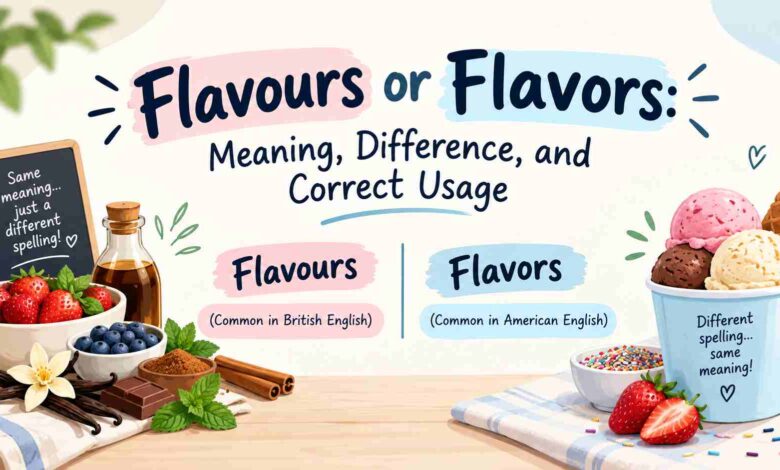
If you’ve ever paused mid-sentence wondering whether to type flavours or flavors, you’re not alone. This is one of the most common spelling mix-ups in English, and the good news is that the answer isn’t complicated at all.
Flavours and flavors mean exactly the same thing — they refer to the taste, smell, or distinctive quality of food, drinks, or experiences. The only difference is regional spelling. Flavours is the British English spelling (also used in Canada, Australia, New Zealand, and Ireland), while flavors is the American English spelling.
In this guide, you’ll learn what the word means, where each spelling comes from, how to pick the right one for your audience, and how this same rule applies to related words like flavoured/flavored and flavouring/flavoring.
Table of Contents
- Flavours or Flavors: The Quick Answer
- What Does the Word Mean?
- Flavours or Flavors: Which Spelling Is Correct?
- Where Does Each Spelling Come From?
- Flavours vs Flavors: Regional Usage Around the World
- Related Word Forms
- Pronunciation: Is There Any Difference?
- Flavours or Flavors in Business, Branding, and Content Writing
- Common Mistakes to Avoid
- Quick Comparison Table
- Frequently Asked Questions
- Final Takeaway
Flavours or Flavors: The Quick Answer
Both spellings are correct. Neither one is “wrong,” and neither is more formal or more proper than the other. The choice simply comes down to which variety of English you’re writing in.
| Spelling | English Variety | Where It’s Used |
|---|---|---|
| Flavours | British English | UK, Canada, Australia, New Zealand, Ireland, South Africa |
| Flavors | American English | United States |
A simple way to remember it:
If your readers say “colour,” “favourite,” and “neighbour,” they’ll expect flavours. If your readers say “color,” “favorite,” and “neighbor,” they’ll expect flavors.
What Does the Word Mean?
Before getting into spelling, it helps to understand what the word actually describes. Flavour/flavor refers to more than just taste — it’s the full sensory experience created by taste, smell, and even texture combined.
The word can be used in a few different ways:
- The taste of food or drink — “This curry has a rich flavour.”
- A specific variety or type — “What flavour of ice cream do you want?”
- A distinctive quality or atmosphere — “The city has a unique cultural flavour.”
- As a verb, meaning to season something — “Garlic flavours the sauce.”
Notice that none of these meanings change based on spelling. Whether you write it with a u or without one, you’re talking about the exact same concept.
Flavours or Flavors: Which Spelling Is Correct?
Here’s the simplest rule you’ll ever need:
- Writing for American readers? Use flavors.
- Writing for British, Canadian, Australian, or Irish readers? Use flavours.
- Not sure who your audience is? Pick one spelling and stay consistent throughout your writing. Switching between the two in the same document — even if each individual sentence is technically correct — looks careless.
For example, this looks inconsistent:
The bakery offers many delicious flavors, and each flavour is made from scratch.
A cleaner version picks one spelling and sticks with it:
The bakery offers many delicious flavors, and each flavor is made from scratch.
If you’re curious about other spelling pairs that trip writers up the same way, it’s worth checking out [Journeys or Journies: Which Spelling Is Correct?] next.
Where Does Each Spelling Come From?
The split between flavours and flavors goes back much further than modern British and American English.
The word traces back to Old French flaor, related to scent and aroma, which itself has roots in a Vulgar Latin term connected to flator — associated with blowing or breath. Over the centuries, the meaning shifted from describing smell to describing taste, a change that became firmly established by the late 1600s.
For a long time, English writers on both sides of the Atlantic used the -our spelling. That changed with American lexicographer Noah Webster, who published influential dictionaries in the early 1800s (most notably his 1828 An American Dictionary of the English Language). Webster wanted American English to have its own identity and believed spelling should be simpler and more phonetic. He dropped the silent u from a whole group of words:
| British Form | American Form |
|---|---|
| colour | color |
| honour | honor |
| labour | labor |
| favour | favor |
| flavour | flavor |
| neighbour | neighbor |
Britain, meanwhile, kept the traditional -our spellings rooted in French influence. That historical divide is exactly why the two forms exist side by side today.
Flavours vs Flavors: Regional Usage Around the World
Spelling conventions generally follow old colonial and cultural ties, not just geography. Here’s how it breaks down:
| Country/Region | Preferred Spelling |
|---|---|
| United States | Flavors |
| United Kingdom | Flavours |
| Canada | Flavours |
| Australia | Flavours |
| New Zealand | Flavours |
| Ireland | Flavours |
| South Africa | Flavours |
Canada is worth a special mention. Canadian English blends American and British influences, but for this particular word group, it generally leans British — so flavours is the standard choice for Canadian writing, even though Canadians pick up plenty of American vocabulary elsewhere.
Related Word Forms
The spelling rule doesn’t stop at the base word — it carries through to every form.
| American English | British English |
|---|---|
| flavor | flavour |
| flavors | flavours |
| flavored | flavoured |
| flavoring | flavouring |
| flavorful | flavourful |
| flavorless | flavourless |
A common mistake is mixing these forms — for example, writing “flavored” in an otherwise British piece, or “flavouring” in an American one. If you’re committing to one spelling variety, apply it consistently across every related word, not just the main noun.
Pronunciation: Is There Any Difference?
No — not in any meaningful way. Both words are pronounced almost identically:
- American: /ˈfleɪ.vɚ/
- British: /ˈfleɪ.və(r)/
Say it out loud and it comes out roughly as “FLAY-vur” either way. Any tiny variation in the final sound comes from general accent differences (like whether the speaker pronounces the “r” at the end), not from the spelling itself. The extra u in flavour is silent — it doesn’t add a sound.
Flavours or Flavors in Business, Branding, and Content Writing
This distinction matters more than people expect once money and branding are involved.
Food and beverage packaging: A product labeled “Vanilla Flavor” in the US market would typically read “Vanilla Flavour” on UK shelves. Getting this wrong on packaging or a menu can make a brand look like it doesn’t understand its own market.
Websites and marketing copy: Many global brands run separate versions of their site for different regions — a US version using flavor, favorite, and color, and a UK/Australian version using flavour, favourite, and colour. This kind of localization signals attention to detail and makes content feel native to the reader rather than imported.
Blog and SEO content: If you’re writing content for a mixed international audience, decide on a primary audience first, then apply that spelling consistently across the whole piece — including headings, meta descriptions, and image alt text. Search engines don’t penalize either spelling, but a scattered, inconsistent approach reads as unpolished to human readers.
Academic and professional writing: Universities and publications usually specify a required style guide. If you’re told to follow British or American English conventions, that instruction overrides your personal habit.
Common Mistakes to Avoid
- Treating them as two different words. They’re not — it’s one word with two accepted spellings.
- Assuming one version is more “correct” or more formal. Neither spelling outranks the other; correctness depends entirely on audience.
- Mixing spellings randomly in the same document. This is the most common and most noticeable error.
- Changing the main word but forgetting the derivatives. If you write flavors, make sure you also use flavored and flavoring, not flavoured and flavouring.
- Assuming the pronunciation changes. It doesn’t — the u is silent in flavour.
Quick Comparison Table
| Question | Answer |
|---|---|
| Are flavours and flavors different words? | No — same word, different regional spelling |
| Which is British? | Flavours |
| Which is American? | Flavors |
| Do they mean the same thing? | Yes |
| Are they pronounced differently? | Essentially no |
| What does Canada use? | Flavours |
| What matters most when choosing? | Audience and consistency |
Frequently Asked Questions
Is it flavours or flavors?
Both are correct. Flavours is the British English spelling, and flavors is the American English spelling. The right one depends on which variety of English your audience uses.
Do flavours and flavors mean the same thing?
Yes, completely. Both describe the taste, smell, or distinctive character of food, drink, or an experience. There’s no difference in meaning — only in spelling.
Which spelling does Canada use, flavours or flavors?
Canada generally uses flavours, following British spelling conventions, even though Canadian English mixes in some American habits elsewhere.
Why does the British spelling have an extra “u”?
The -our ending reflects the word’s older French-influenced roots, which British English kept. American English dropped the u in the early 1800s, largely due to Noah Webster’s spelling reforms aimed at simplifying and standardizing American English.
Are flavours and flavors pronounced differently?
Not in any noticeable way. Both are pronounced roughly as “FLAY-vur.” The extra u in the British spelling is silent.
Is it wrong to use flavor in British English or flavour in American English?
Readers will still understand you either way, but it won’t match the expected local convention. If you’re writing specifically for a British or American audience, it’s best to match their standard spelling.
What about flavoured/flavored and flavouring/flavoring?
The same rule applies. American English uses flavored and flavoring; British English uses flavoured and flavouring. Keep the spelling consistent with whichever main form you’re using.
Can I use both spellings in the same article?
You can mention both once to clarify the difference for readers, as this article does, but you shouldn’t alternate between them randomly throughout a piece. Pick one spelling as your standard and stay consistent.
Final Takeaway
Flavours and flavors are the same word wearing two different regional outfits. There’s no meaning difference and barely any pronunciation difference — the entire decision comes down to who you’re writing for.
- Writing for American readers → use flavors
- Writing for British, Canadian, Australian, or Irish readers → use flavours
- Whichever you choose, apply it consistently across the whole piece, including related words like flavored/flavoured and flavoring/flavouring
Once you know your audience, the choice takes about two seconds — and your writing looks more polished for it.