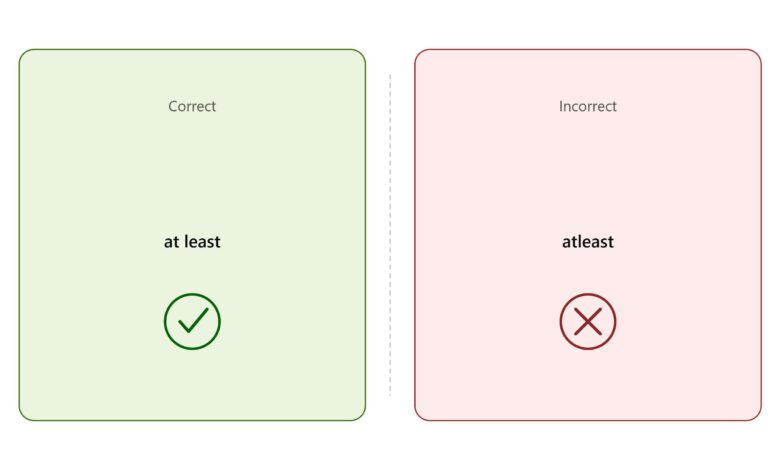
If you’ve ever paused mid-sentence wondering whether to type “at least” or “atleast,” you’re not alone — and the answer is simple: at least is the only correct spelling. Atleast is a common misspelling that doesn’t appear in any major dictionary, including Merriam-Webster, Oxford, or Cambridge.
This mix-up happens because the phrase is spoken as one smooth sound, so writers assume it should be written the same way — like “already” or “altogether.” But English doesn’t apply that rule consistently, and “at least” is one of the phrases that stays as two separate words no matter how it’s used.
What “At Least” Means
“At least” is an open compound — two words that function together as a single unit but are never merged or hyphenated. It carries three main meanings depending on context:
1. A minimum amount or number
- We need at least five volunteers.
- The repair will cost at least $200.
2. Reassurance or a silver lining
- At least nobody was hurt.
- At least we tried.
3. A qualification that narrows a claim
- The plan works, at least in theory.
- He’s honest, at least most of the time.
If you’re curious how another commonly confused word pair gets sorted out, it’s worth checking out my [Brumeblog Com Review: What It Is, What It Covers, and Whether It’s Worth Reading (2026 Guide)] before you go.
Why “Atleast” Is Never Correct
Writers often assume “at least” follows the same pattern as closed compounds like already, altogether, or anyway — words that started as two words and eventually fused into one. But that fusion never happened with “at least.” It has stayed grammatically open in both American and British English, in every style guide, and across formal and informal writing alike.
A quick comparison:
| Form | Status | Meaning |
|---|---|---|
| At least | Correct | Minimum, consolation, or qualification |
| Atleast | Incorrect | Not a recognized word |
Search engines returning results for “atleast” doesn’t validate it — it just reflects how often people mistype it. Popularity isn’t proof of correctness.
Open Compounds vs. Closed Compounds
Understanding compound types explains why this rule exists:
- Open compound (two separate words): at least, in fact, at first, of course
- Closed compound (one word): already, altogether, anyway
- Hyphenated compound: well-known, self-aware
There’s no reliable shortcut for knowing which category a phrase falls into — you have to check it, especially with expressions that “feel” like they should be single words.
Common Mistakes to Avoid
Writing it as one word ❌ atleast ten people arrived ✅ at least ten people arrived
Confusing “at least” with “at last” These look and sound similar but mean opposite things in tone:
- At least = minimum or consolation (“We need at least ten chairs.”)
- At last = finally (“The train arrived at last.”)
Overusing “at the least” “At the least” isn’t wrong, but it sounds stiff and dated compared to “at least” in modern writing. Stick with “at least” unless you have a specific stylistic reason not to.
How “At Least” Behaves Grammatically
“At least” functions as an adverbial phrase, meaning it can modify a number, a verb, or an entire clause:
- Modifying a quantity: Buy at least six.
- Modifying a clause: At least we have options.
This flexibility is also why punctuation around it varies. A comma often follows “at least” when it introduces a full clause conversationally (At least, we survived.), but no comma is needed when it’s directly tied to a quantity (We need at least ten volunteers.).
Where “At Least” Sits in a Sentence — and Why It Changes the Tone
Position isn’t just a style choice; it shifts what the phrase is doing.
At the start of a sentence, “at least” usually softens or reframes what follows, almost like a verbal shrug:
- At least we have a backup plan.
- At least nobody panicked.
In the middle of a sentence, it usually locks onto a specific number or noun and means exactly “no less than”:
- We have at least a backup plan. (there may be more than one)
- At least ten people panicked. (a literal count)
Notice how the first pair reads conversationally, almost like consolation, while the second pair reads like a hard fact. Same two words, different job, depending only on where they land.
Comma placement follows the same logic. When “at least” opens a sentence and introduces a full clause in a conversational tone, a comma often follows it:
- At least, we managed to finish on time.
When it’s directly attached to a number or noun, skip the comma entirely:
- We finished with at least three days to spare.
Getting this wrong doesn’t usually create a grammar error so much as an awkward rhythm — but in edited, professional writing, rhythm counts.
Other Two-Word Phrases People Mistakenly Merge
“At least” isn’t the only expression that trips up writers who assume closed-compound status. Recognizing the pattern helps you catch these before they get published:
| Correct (two words) | Incorrect (merged) |
|---|---|
| At least | Atleast |
| A lot | Alot |
| In fact | Infact |
| Of course | Ofcourse |
| Each other | Eachother |
| All right | Alright (informal only) |
Note that “all right” is a slightly different case — “alright” has crept into informal and creative writing as an accepted variant for some style guides, but “atleast” has no such exception anywhere. That’s worth knowing if you’re ever tempted to use the “well, alright is sort of accepted” argument to justify “atleast” — the two aren’t in the same category.
Where You’ll See “At Least” in Real Writing
- Journalism: “The storm caused delays lasting at least ten hours.”
- Business writing: “Orders require at least 48 hours for processing.”
- Academic writing: “Participants needed at least two years of experience.”
- Everyday speech: “At least call me first.”
Even in the idiom “last but not least,” the word “least” stays separate — there’s no version of this phrase in English where it merges into one word.
Why This Small Spelling Choice Matters
A single misspelling like “atleast” won’t derail an otherwise strong piece of writing, but repeated small errors add up. On a resume, in a client proposal, or in published content, they signal a lack of attention to detail — and that’s the kind of thing readers and hiring managers notice even when they can’t articulate why something feels “off” about a piece of writing.
The fix is simple: whenever you mean “no less than,” write it as two words — at least — every time.
FAQs
Is atleast correct or should I use at least?
“At least” is the only correct spelling. “Atleast” is a misspelling and should never be used in formal or professional writing.
What is the difference between at least vs atleast?
“At least” is standard English recognized by every major dictionary and style guide. “Atleast” isn’t a recognized word at all — it’s simply an incorrect merging of two separate words.
Why do people confuse at least and atleast?
The confusion comes from pronunciation. Spoken aloud, “at least” sounds like a single word, which leads some writers to assume it should be written that way — similar to how “already” or “altogether” merged over time.
Does British English or American English use “atleast”?
No. Neither variety of English recognizes “atleast” as a word. Both British and American English use “at least” as two words in all contexts.
How can I avoid this spelling mistake?
Use your word processor’s find function to search for “atleast” before publishing anything. If it appears, replace it with “at least.” Building this into your proofreading routine eliminates the error for good.
Can “at least” start a sentence?
Yes. Starting a sentence with “at least” is grammatically correct and common in everyday writing — it typically softens a statement or offers reassurance, as in “At least we tried.”
Is “at least” the same as “at the least”?
They mean nearly the same thing, but “at least” is the far more natural, modern choice. “At the least” isn’t incorrect, but it tends to sound stiff or old-fashioned in everyday and business writing.
Conclusion
The rule is straightforward: at least is correct, atleast is not. Whether you’re describing a minimum number, softening bad news, or qualifying a claim, the spelling never changes — it’s always two words. Get in the habit of double-checking it, and it becomes second nature.